

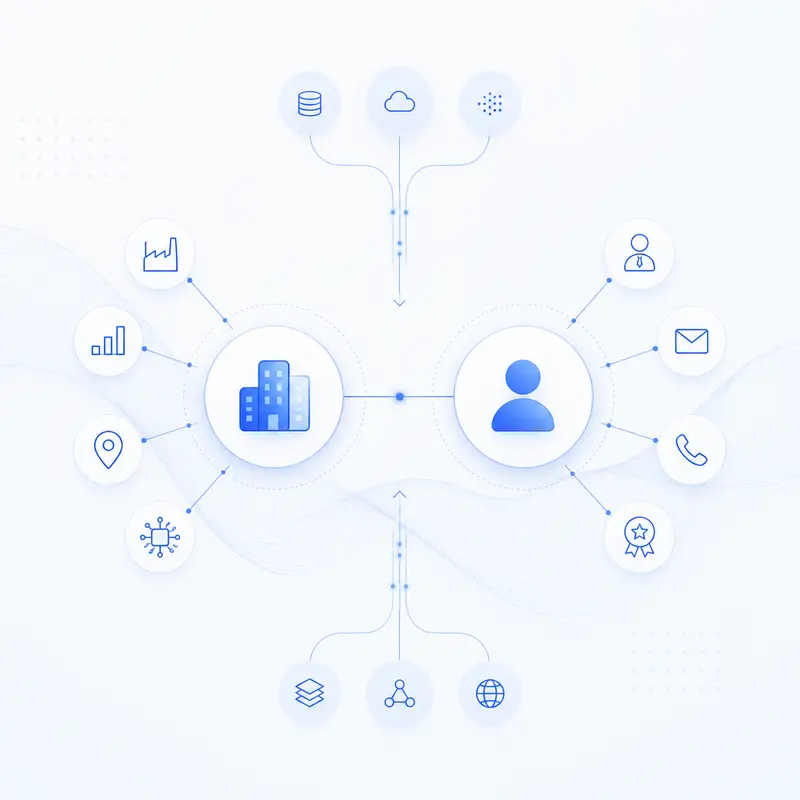
Definitions: company enrichment and contact enrichment
Company enrichment adds firmographic and account-level context to a business record. Its purpose is to identify what the company is, how big it is, what it does, where it operates, and which technologies and events might signal buying interest. In practical terms, company enrichment turns a bare domain or company name into an actionable account profile your teams can segment, score, route, and prioritize.
Contact enrichment adds person-level context to an individual record. Its purpose is to identify who the person is at that company, what they do, how senior they are, and how to reach them. It turns a first name, last name, or email into a complete prospect profile your SDRs and marketers can personalize and engage.
Primary problems each solves:
- Company enrichment: Poor ICP fit visibility, weak account prioritization, mismatched territories, duplicate or unlinked subsidiaries, limited ABM segmentation, and manual research on target accounts.
- Contact enrichment: Low deliverability and connect rates, lack of decision-maker visibility, generic outreach, orphaned leads without an account, and slow SDR ramp due to missing context.
Expected output fields
- Company enrichment outputs typically include: legal name and aliases, website/domain, industry/NAICS-like categories, revenue band, employee count (global/by location), HQ and locations, ownership type, year founded, technographics, funding stage/announcements, hiring velocity, leadership changes, intent or buying signals, social profiles, description/keywords, phone, and standardized identifiers for deduplication.
- Contact enrichment outputs typically include: full name, preferred name, title, department/function, seniority, role persona, business email, verification status, phone (direct/desk), location/time zone, manager/organization hints, start date/tenure, and professional social profiles.
Typical users and workflows
- Sales and SDR teams: Prospect list building, multi-threading into accounts, territory planning, and prioritizing sequences based on firmographic fit and buying signals.
- Marketing and Demand/ABM: Audience building by industry and size, dynamic web and email personalization, event targeting, and content mapping to roles and seniorities.
- RevOps: Lead routing and deduplication, CRM hygiene, SLA enforcement, and attribution fidelity.
- Customer Success/Account Management: Account planning, whitespace analysis, and identifying new stakeholders for expansion.
Where it fits with KatalystIQ: KatalystIQ continuously enriches both companies and contacts as part of its Lead Machines. It detects buying signals at the account level, appends contact details, scores opportunities, and generates AI-personalized outreach—so enriched data becomes immediately actionable in workflows and CRM syncs.
Core differences: entity, granularity, and identifiers
At a high level, the company enrichment vs contact enrichment decision maps to the entity you need to act on and the granularity of insight required.
Entity focus
- Company enrichment is account-level. It answers: Should we spend cycles on this business? Who owns it? How does it map to territories and ABM tiers? What intent or changes indicate timing?
- Contact enrichment is person-level. It answers: Who at this account should we speak with? Are they a decision maker or influencer? How do we reach them and tailor the message?
Granularity and scope
- Company data is broader and more stable (industry, size, locations, technographics, org hierarchy). It supports ICP scoring, territory models, ABM tiers, and forecasting inputs.
- Contact data is narrower and more volatile (titles, phones, reporting lines). It supports persona-based messaging, direct outreach, and multi-threading.
Common matching keys and identifiers
- Company matching keys: primary domain, legal name and aliases, HQ address, phone, country/registration hints, and standardized internal IDs. Domains are the most common key but must be handled carefully for shared or redirected domains.
- Contact matching keys: business email (strongest), full name + company/domain + title, professional profile URLs, and phone. Email is the most reliable identifier for deduplication and identity resolution.
Typical attributes for quick reference
- Company attributes: industry, revenue band, employees, HQ/country/region, locations count, ownership (public/private), technographics, recent funding or hiring velocity, parent-subsidiary relationships, main phone, social links.
- Contact attributes: title, department/function, seniority, responsibilities, verified email, direct dial, location/time zone, professional profile URL, start date/tenure, manager indicator.
Impact on record linking, deduplication, and hierarchies
- Linking: Contacts must attach to the correct account. Company enrichment normalizes domains and names, which improves contact-to-account matching and prevents orphaned leads.
- Deduplication: At the company level, use domain + legal name + HQ to collapse duplicates while honoring subsidiaries and brands. At the contact level, email is the canonical dedupe key; name/title-only matching risks false merges.
- Hierarchies: Company enrichment should establish parent-child and location hierarchies. This supports ABM rollups, territory coverage, and multi-threading strategies that engage both HQ stakeholders and regional buyers.
Operational note with KatalystIQ: The platform correlates buying signals at the company level (e.g., hiring engineering managers, leadership changes) and then surfaces relevant contacts with the right roles. That linkage is what makes outreach timely and targeted without manual cross-referencing.
Common data attributes and enrichment outputs
Company attributes to expect
- Firmographics: legal name, domain, industry classification, revenue band, employee counts, ownership type, year founded.
- Locations: HQ address, regional offices, country/region/state standardization, geo coordinates (where applicable).
- Technographics: inferred technologies and categories in use.
- Signals: hiring velocity, funding announcements, leadership moves, website changes, and other intent-like indicators.
- Identifiers and hygiene: standardized IDs, aliases, match method, last seen/updated timestamps.
Contact attributes to expect
- Identity: full name, preferred name, title, department/function, seniority band, persona tag.
- Reachability: business email with verification status, direct/desk phone, time zone, location.
- Context: start date/tenure, manager hints, professional profile URLs.
Provenance and confidence
- Include fields like sourcetype, sources, matchmethod, confidencescore, and lastverified_at. Confidence represents how certain the system is about a field, not the field’s business value. Use it to govern routing, personalization, and when to trigger re-enrichment.
Common source types
- Public company registries and filings, official websites and web crawl, job postings and career pages, news and press, analyst write-ups, social and professional profiles, product documentation artifacts, and proprietary intent or behavioral signals.
Short example enriched records (illustrative only)
Example company record
- companyid: cmp87342
- legal_name: Acme Robotics, Inc.
- domain: acmerobotics.example
- industry: Industrial Automation
- revenue_band: 50–100M
- employees_global: 420
- hq_location: San Jose, CA, US
- locations: [US, DE]
- ownership: Private
- technographics: [“Cloud CRM”, “Marketing Automation”, “Robotic Controllers”]
- signals: {hiringvelocity: “rising”, leadershipchange: true}
- phone: +1-408-555-0142
- social: {linkedin: “linkedin.com/company/acme-robotics”}
- hierarchy: {parent_company: null, subsidiaries: [“Acme Robotics GmbH”]}
- provenance: {sourcetype: [“webcrawl”, “publicrecords”], matchmethod: “domain+name”, confidencescore: 0.93, lastverified_at: “2026-08-02”}
Example contact record
- contactid: cnt55910
- full_name: Jordan Patel
- title: Director of Operations
- department: Operations
- seniority: Director
- email: jordan.patel@acmerobotics.example
- email_verification: valid
- phone_direct: +1-408-555-0199
- location: San Jose, CA, US
- persona: “Ops Leader”
- social: {linkedin: “linkedin.com/in/jordanpatel”}
- employer: {companyid: cmp87342, domain: acmerobotics.example}
- provenance: {sourcetype: [“professionalprofile”, “emailverification”], matchmethod: “email+domain”, confidencescore: 0.97, lastverified_at: “2026-08-03”}
How KatalystIQ helps: The platform aggregates multiple source types, appends provenance and confidence scores, and ties company signals (such as hiring sprees or technology changes) to relevant contacts. Those enriched records can then feed qualification rules and AI-personalized outreach automatically.
Primary use cases by team and objective
Sales prospecting and SDR outreach
- List building: Combine company enrichment (industry, size, technographics) with contact enrichment (titles, seniority) to assemble persona-aligned target lists.
- Prioritization: Use buying signals like funding or leadership changes at the company level, paired with verified contact data, to focus sequences where timing is best.
- Personalization: Reference company context (new data center, recent expansion) and contact context (role responsibilities) to craft specific, relevant messages.
- Multi-threading: Enrich multiple stakeholders across functions (Ops, Finance, IT) for higher access and risk mitigation when a champion changes roles.
Marketing segmentation, personalization, and ABM
- Segmentation: Build dynamic audiences by industry, revenue band, employee ranges, regions, and installed technologies; layer in contact roles and seniorities for persona-based messaging.
- Personalization: Tailor content offers and landing pages using firmographic context and role-specific pain points.
- ABM: Rank accounts by ICP fit and intent, then map the buying committee with contact enrichment. Coordinate ads, email, and SDR plays against the same enriched data.
Lead routing, SLA, and sales automation
- Routing: Assign leads by territory, segment, or product line using enriched industry, revenue, or employee counts; ensure contacts link to the right account to avoid SLA leakage.
- Automation: Trigger sequences and handoffs based on enrichment thresholds (e.g., verified email + ICP grade A) and pause or recycle when confidence is low.
Customer success and account expansion analytics
- Stakeholder mapping: Enrich new users and contacts inside active accounts to maintain coverage despite turnover.
- Whitespace and expansion: Use company hierarchies and locations to identify untapped subsidiaries or regions. Combine with contact roles to drive cross-sell plays.
Analytics, reporting, and forecasting
- Pipeline analytics: Measure coverage and conversion by ICP attributes and persona mix. Identify which combinations of company and contact factors correlate with wins.
- TAM and planning: Use enriched firmographics to size markets, allocate territories, and forecast demand by segment.
Operationalizing with KatalystIQ: Teams can deploy Lead Machines to continuously discover accounts with the right firmographic fit, detect buying signals, enrich decision makers, and launch AI-personalized outreach. Workflow Automation and CRM integrations keep routing, SLAs, and reporting aligned without manual effort.
How enrichment affects lead scoring and segmentation
Lead and account scoring work best when they blend two perspectives: account fit from company enrichment and person fit from contact enrichment. Thinking in terms of company enrichment vs contact enrichment helps you decide which signals should shape ICP fit, which should drive prioritization, and how to segment effectively.
Company attributes inform account-level scoring and ICP fit. Firmographic and technographic fields tell you whether an account is worth pursuing in the first place.
- Fit signals: industry, employee range, revenue band, HQ region, locations, technology stack, growth indicators (hiring trends, funding, expansion), and company model (SaaS, services, marketplace).
- Intent and timing: recent buying signals and category research patterns can raise or lower an account score even if fit is average.
- Practical use: tier accounts (A/B/C), qualify into ABM lists, and set routing rules (enterprise queue vs mid-market) based on these fields.
Contact attributes influence individual lead scores and outreach prioritization. Once an account is attractive, you still need the right people and the right channel.
- Persona match: function, role, and seniority determine whether a person is a decision-maker, influencer, champion, or blocker.
- Reachability: validated email, phone, time zone, and preferred channel improve the likelihood of response.
- Quality cues: job tenure, team size owned, and relevant certifications suggest authority and urgency; generic or role-based emails may lower priority.
Combined company + contact signals strengthen predictive models. Even simple rule-based scores improve when you combine fit, intent, and engagement at both levels.
- A practical structure: Score = Account Fit + Account Intent + Contact Fit + Contact Engagement. Keep each component explainable and thresholded, then weight them to match your sales motion.
- For example, a Director of Operations at a target-size logistics company adopting a relevant technology in the past 60 days should outrank a VP at a small non-ICP firm, even if the title is more senior.
Use enrichment to build actionable segments for campaigns. Segments should be specific enough to shape messaging and channel choices.
- Account-led segments: “North America, 200–1,000 employees, financial services, using cloud data warehouse, hiring data engineers.”
- Contact-led segments inside those accounts: “Data leaders (Director+), operations influencers (Manager–Senior Manager).”
- Campaign design: pair vertical pain points (company-level) with persona pain points (contact-level) to drive relevance.
Common scoring pitfalls when enrichment is partial or low confidence.
- Over-indexing on a single field. Titles vary widely; use seniority + function + scope rather than title alone.
- Treating unknown as zero. Unknown revenue or employee count should not destroy a fit score—use neutral defaults and confidence-weighted logic.
- Static scores that ignore signal decay. Intent and engagement should decay over time; company fit should re-evaluate after major events like funding or M&A.
- Duplicate and conflicting records. Without solid record linking, you will double-count engagement and distort scores.
- One-size-fits-all thresholds. Enterprise and SMB motions often need different weights and pass/fail rules.
Where it fits with KatalystIQ. KatalystIQ combines B2B lead enrichment, buying signals detection, and AI Lead Qualification so your team can weight account fit and contact priority in one place. You can configure scoring rules, route by ICP tiers, and let AI suggest outreach priorities using the combined signals—then push those scores into your CRM and marketing automation for action.
Implementation approaches: real-time, batch, and hybrid
Use different enrichment patterns for different moments in the lifecycle. The right mix balances speed, coverage, cost, and operational simplicity.
Real-time API enrichment at form submit and inbound capture.
- What to enrich: only the fields required for routing, ownership, and quick personalization (e.g., company match, employee band, region, role/seniority, email validity).
- Performance tactics: set a strict response time budget, use asynchronous fallbacks if an API is slow, and avoid calling multiple providers synchronously on the user’s critical path.
- Data hygiene: standardize domains, validate emails, and deduplicate before enrichment to reduce wasted calls.
- Fallback flow: if enrichment fails, create the record with minimal data, flag it for retry, and route to a general queue temporarily.
Use batch enrichment for backfills, nightly jobs, and data hygiene.
- Backfills and migrations: normalize legacy CRM and MA databases before new campaigns and before deploying lead scoring changes.
- Rolling hygiene: nightly or weekly jobs to fill new fields, refresh decayed attributes, and fix orphans (contacts without matched accounts).
- Event-driven re-enrichment: trigger batch jobs after known change events like domain changes, email bounces, or detected company milestones.
Hybrid patterns for performance and cost.
- Minimal real-time, rich nightly: fetch only routing-critical fields in real time, then append technographics, social links, phone numbers, and extra firmographics overnight.
- Progressive profiling: collect the rest during future interactions; use marketing automation to fill gaps passively over time.
- Triggered refreshes: when buying signals spike for an account, refresh all related contacts to ensure accurate personas and channels.
ETL, middleware, and orchestration considerations.
- Idempotency and keys: always enrich against stable identifiers (account external ID, email, domain). Store vendor IDs for faster subsequent lookups.
- Queues and retries: use message queues with exponential backoff for rate limits and transient errors. Log every attempt with timestamps and outcomes.
- Field-level updates: only overwrite fields if the new value is higher confidence or fresher than what you have; keep provenance metadata.
Caching strategies, rate-limit handling, and SLA impacts.
- Short-lived caches for hot campaigns: cache successful company and contact lookups for a reasonable TTL to cut latency and cost.
- Negative caching: briefly cache “not found” responses to prevent hammering providers with repeated misses.
- Concurrency controls: respect provider limits with client-side throttling; prioritize business-critical flows when capacity is constrained.
Recommended enrichment cadence by record type.
- New inbound leads: enrich immediately for routing, then append noncritical fields within 24 hours.
- Net-new outbound lists: enrich before first touch; refresh critical fields (role, email validity) every 60–90 days during active sequences.
- Existing contacts: quarterly refresh or on job-change/bounce signals.
- Accounts: refresh quarterly; accelerate to monthly for ABM tiers or when buying signals (hiring spikes, tech changes, funding) are detected.
How KatalystIQ helps operationalize this. With real-time APIs, CRM integrations, and no-code Workflow Automation, KatalystIQ can enrich at capture, schedule batch backfills, trigger re-enrichment on buying signals, and handle retries—so your teams get the right data at the right moment without manual effort.
Integration patterns with CRM, MA, CDP, and data warehouse
Getting enrichment data into the right systems—and keeping it trustworthy—depends on careful mapping, identity resolution, and governance.
Mapping and naming conventions for enriched fields.
- Use explicit prefixes: enrcompanyindustry, enrcompanyemployeerange, enrcontactseniority, enrconfidence_email.
- Preserve provenance: store enrsource, enrlastupdatedat, and vendor-specific IDs per field or bundle.
- Don’t overwrite core CRM fields blindly. Keep enriched values in separate fields, then use workflows to populate operational fields when confidence thresholds are met.
Linking company and contact records in a CDP and resolving identities.
- Person identity: email (hashed and plain), phone, marketing automation IDs, and device IDs should map to a unified person profile.
- Account identity: primary domain, legal name, and vendor company ID should anchor the account entity; maintain parent-child relationships for hierarchies.
- Person-to-account association: prefer verified corporate email domains; allow manual overrides for exceptions (consultants, holding companies, subsidiaries).
Warehouse-first enrichment and analytic pipelines.
- Centralize raw enrichment outputs in your data warehouse for quality checks, scoring calculations, and historical analysis.
- Apply slowly changing dimensions (SCD) for firmographic history to analyze pipeline against prior company states.
- Push operational slices back to CRM/MA via reverse ETL, keeping only the fields and freshness levels needed for execution.
Sync frequency, merge rules, and conflict resolution.
- Sync critical routing fields frequently (near real time if needed); sync noncritical attributes daily.
- Define a trust hierarchy: for example, user-entered fields override vendor data for names and notes; the freshest, highest-confidence vendor data wins for firmographics.
- Use field-level freshness windows and confidence scores to decide when to overwrite, and keep the last-seen source for auditability.
Monitoring, observability, and data lineage.
- Track match rate, field-level fill rate, freshness (days since update), error rates, and API latency by segment.
- Alert on anomalies: sudden drops in match rate, surge in API failures, or unusual spikes in changed values for a field.
- Maintain lineage: log job IDs, input keys, provider source, confidence, and timestamps so any value can be traced back to its origin.
Where KatalystIQ fits. KatalystIQ’s CRM & Sales Integrations and APIs make it straightforward to map enriched fields, push scores, and link contacts to accounts. Workflows can enforce your merge rules and write-back cadence, while the platform’s data provenance fields help maintain transparency across systems.
Vendor selection and evaluation checklist
Evaluating enrichment partners is about more than price and match rate. Look for verifiable coverage, fresh and accurate data, strong APIs, and predictable operations.
Coverage, freshness, and vertical depth.
- Ask for coverage by region, company size bands, industries, and job seniorities relevant to your ICP.
- Request vertical depth metrics if you sell into niche markets; generic coverage is not a substitute for sector-specific completeness.
- Understand refresh cadence: how often are firmographics, technographics, and contact details updated? What events trigger out-of-cycle refreshes?
Accuracy, validation methods, and sample testing.
- Require clarity on how emails and phones are validated (e.g., deliverability checks, direct dials vs switchboard, inferred vs verified).
- Look for field-level confidence scores and provenance indicators you can store.
- Run a blind sample test: select a stratified set of known records across segments; measure match rate, field-level accuracy, and fill rate. Manually QA a statistically meaningful subset.
API features, latency, pagination, and SLA expectations.
- Evaluate endpoint coverage (company, contact, intent), bulk endpoints, and webhook support for asynchronous jobs.
- Check documented rate limits, retry semantics, error codes, and versioning policies.
- Validate expected latency and uptime SLAs against your routing and user experience requirements.
Pricing models, predictable cost drivers, and overage risk.
- Common models: per-record, per-match, tiered API credits, or subscriptions with volume bands.
- Clarify what counts as a billable event (attempts vs successful matches, partial matches, batch minimums).
- Identify cost drivers: volume, geographies, fields purchased (e.g., phones, technographics), and intent data add-ons. Model your cost-per-enriched-record and run A/B tests to confirm ROI.
Security, compliance certifications, and support SLAs.
- Confirm certifications (e.g., SOC 2, ISO) and review data handling for PII, including storage regions and deletion policies.
- Execute a DPA and review subprocessor lists, acceptable use, and data lineage commitments.
- Assess support coverage, response times, and deprecation/change management practices.
Trial benchmarking and blind testing process.
Define success metrics in advance: target match rate by segment, minimum field-level accuracy, acceptable latency, and expected lift in conversion or response.
Run side-by-side tests when comparing vendors: split your dataset, hold back a control group, and compare downstream KPIs like lead-to-opportunity rate and time-to-first-touch.
Document findings with clear pass/fail criteria and a governance sign-off before scaling.
How this ties back to choosing company enrichment vs contact enrichment. Prioritize testing against the outcomes you need: account coverage and fit for ABM and routing, contact reachability and persona quality for SDR efficiency. Many teams select one vendor for company-level breadth and another for contact-level depth; others choose a platform that operationalizes both. The right choice depends on your ICP, motion, and the lift you can verify in a controlled trial.
Data quality, matching challenges, and maintenance
Quality determines whether enrichment accelerates revenue or creates noise. The data issues you’ll encounter differ between company enrichment and contact enrichment, so plan controls for both.
Common matching challenges to expect:
- Subsidiaries and brand families: A single corporate group can operate dozens of legal entities and brands. Company enrichment must resolve whether your ICP match is the local subsidiary, regional HQ, or ultimate parent. Without hierarchy resolution, routing and reporting break.
- Shared and legacy domains: Conglomerates often share a root domain, while product microsites and acquired domains linger. Matching purely on domain can over-merge unrelated units or miss acquisitions.
- Mergers and rebrands: Names, websites, and locations change. If you don’t canonicalize to a stable company identifier and maintain alias tables, duplicates and stale accounts proliferate.
- Role-based and generic emails: Addresses like sales@ or info@ rarely map to a real person and inflate contact coverage without improving outreach results.
- Aliases and nicknames: Contacts may use shortened names, maiden names, or transliterations across systems. Fuzzy matching must be carefully bounded to avoid false positives.
- Orphaned contacts: Contacts captured from events or uploads without a domain or company link become stranded in CRM, degrading segmentation and lead routing.
How to canonicalize and resolve hierarchies:
- Establish a company identity spine: prefer stable identifiers like legal name + registration geography, primary domain, and headquarters address as composite keys. Maintain an alias dictionary for former names and brands.
- Track parent-child relationships: store fields for immediate parent, ultimate parent, and sibling flags. Design routing and roll-up reporting to respect these levels.
- Control merge rules: decide when to merge subsidiaries into a parent (e.g., for enterprise ABM) and when to keep them separate (e.g., region-specific selling teams). Document this logic and make it consistent.
Handling tricky contact scenarios:
- Devalue role-based emails in scoring and suppress for SDR sequences unless paired with strong intent signals.
- Use structured name parsing and conservative fuzzy-matching on name + company + title. Require at least one high-confidence anchor (verified email, direct dial, or authoritative social profile).
- Resolve orphaned contacts by extracting candidate domains from emails, signatures, or URLs in notes, then attempt company enrichment. Unmatched records should enter a review queue or a “quarantine” segment.
Monitoring data decay and triggering maintenance:
- Expect continuous drift: titles change, teams reorganize, companies move or rebrand. Build automated re-enrichment when signals indicate change—email bounces, new funding, leadership shifts, headcount spikes, or site updates.
- Set cadences: company attributes age more slowly than contact attributes. Batch-refresh firmographics and technographics on a periodic schedule, while contact fields re-enrich more frequently or on-demand after engagement.
- Track quality KPIs: match rate, precision (manual spot-checks), enrichment coverage by field, duplicate rate, hierarchy accuracy, bounce rate, and time-to-correct.
Human review and feedback loops:
- Confidence thresholds: route low-confidence or conflicting matches to a human review queue. Capture the reviewer’s disposition to improve future matching logic.
- Correction workflows: enable sellers and ops to flag bad data in CRM with a standardized reason code. Sync those corrections back to your enrichment pipeline and, where possible, to the vendor.
- Playbooks for exceptions: document how to handle ambiguous entities, global groups, and new brands so decisions stay consistent across teams.
Where KatalystIQ helps: With workflow automation and buying signal detection, you can trigger re-enrichment when company events occur, route uncertain records for review, and keep CRM and marketing automation synchronized. KatalystIQ’s lead enrichment and CRM integrations can also link contacts to accounts and update fields without manual effort.
Privacy, compliance, and ethical considerations
Company-level data generally poses fewer restrictions than contact-level data, but both require responsible handling. Treat compliance as an enablement function—good governance preserves deliverability, reputation, and long-term reach.
Key regulatory themes to account for (high level, not legal advice):
- Lawful basis: For contact enrichment, ensure you have a valid legal basis under regional laws (e.g., consent or legitimate interest for B2B outreach where applicable). Document your assessment and apply it consistently.
- Transparency and rights: Be clear in your privacy notices about data sources, purpose of processing, and retention. Provide accessible mechanisms for individuals to exercise rights such as access, correction, and objection.
- Data minimization: Enrich only the fields you need for clear purposes like segmentation, lead routing, or personalization. Avoid sensitive or irrelevant attributes that increase risk without business value.
- Retention and purpose limitation: Establish retention schedules. Purge or anonymize stale contact data and remove records that have opted out or are no longer relevant to your ICP.
- Vendor contracts and due diligence: Execute data processing agreements, review security practices, understand subprocessors, and verify cross-border transfer mechanisms when data moves internationally.
- Security and access controls: Apply role-based access, encryption in transit and at rest, audit logs, and least-privilege principles—especially for contact-level data.
Practical safeguards for enrichment workflows:
- Build suppression logic: honor do-not-contact and regional marketing preferences before any outreach personalization or uploads to ad platforms.
- Store provenance: keep source and timestamp fields so you can honor correction or deletion requests and evaluate data quality over time.
- Segment by jurisdiction: apply region-aware rules that adjust enrichment depth and outreach eligibility based on geography.
Where KatalystIQ helps: Use workflow automation to enforce suppression lists, restrict downstream syncs based on region or purpose, and keep provenance fields mapped into your CRM. KatalystIQ’s secure cloud platform and integrations make it easier to operationalize privacy-centric processes without custom engineering.
Cost models, ROI drivers, and KPIs to track
Budgeting for enrichment is as much about precision as it is about price. Understand how vendor charging works, quantify value by stage, and instrument your stack to see causal impact on pipeline.
Common pricing approaches and cost drivers:
- Per-record or per-match fees: predictable on small volumes, but watch overage risk with large backfills.
- Subscription tiers: pay for a defined dataset, feature set, or monthly match quota. Useful for steady-state programs.
- Tiered API usage: costs vary by endpoint, field bundle, or latency SLA. Real-time lookups often command a premium.
- Hidden multipliers: retries, dedup passes, and enrichment at multiple lifecycle stages can multiply cost—model them explicitly.
Estimating ROI from enrichment:
- Time saved: quantify manual research minutes reduced per lead or account. Multiply by hourly fully loaded cost for SDRs/BDRs.
- Conversion lift: compare lead-to-opportunity and opportunity-to-close rates for enriched vs. unenriched cohorts.
- Speed to first touch: measure reduction in time from capture to first personalized outreach—faster follow-up tends to lift response.
- Campaign efficiency: evaluate cost per meeting or per opportunity for segments unlocked by enrichment (e.g., new ICP tiers or technographic filters).
A simple way to frame value:
- Incremental pipeline = (Leads touched) x (Uplift in conversion rate) x (Average deal size)
- Incremental contribution margin = Incremental pipeline x (Win rate) x (Gross margin)
- Net ROI = Incremental contribution margin − Enrichment cost
Core KPIs to track:
- Match rate and field coverage by segment (ICP vs. non-ICP)
- Accuracy proxy metrics: bounce rate, validation pass rate, and manual spot-check precision
- Lead-to-opportunity uplift for enriched cohorts
- Pipeline velocity impacts: opportunities x win rate x average deal size ÷ sales cycle length
- Cost-per-enriched-record and marginal value per field bundle
Spend optimization tactics:
- Prioritize by intent: use real-time enrichment for high-intent inbound and hot buying signals; queue low-intent or cold records for batch.
- Enrich minimally at first touch: collect only the fields needed for routing and fast personalization; defer deeper firmographics until MQL or meeting set.
- Sample and test: A/B test field bundles and sources. If a field doesn’t improve lead scoring, routing accuracy, or conversion, drop it.
- Tier by ICP: invest more enrichment depth for Tier 1 accounts and budget accounts near buying windows.
Where KatalystIQ helps: KatalystIQ can route records through different enrichment and outreach paths based on buying signals and segment tags, making it easier to reserve premium, real-time enrichment for prospects most likely to convert. Its analytics and workflow automation support the sampling and A/B methodologies needed to validate ROI.
Best practices and common mistakes to avoid
Dial in your enrichment program to maximize impact while minimizing cost and operational drag.
Recommended cadences and when to defer:
- Real-time: apply at inbound form submit or chat, but restrict to the minimum set needed for routing and immediate personalization.
- Scheduled batch: refresh company attributes on a slower cadence; refresh contact attributes more frequently or upon engagement changes.
- Event-driven: trigger re-enrichment after bounces, role changes, buying signals, or company events like funding or leadership turnover.
- Defer when uncertain: if a record doesn’t meet confidence thresholds or lacks identifiers, park it for manual review instead of forcing a weak match.
Prioritize high-value fields and use cases first:
- Start with fields that power lead routing, SLA adherence, and targeting (e.g., company size, industry, territory, verified role, seniority).
- For company enrichment vs contact enrichment, align with objectives: ABM and territory planning benefit most from accurate company hierarchies and firmographics; high-velocity outbound and inbound qualification rely more on verified contact details and role context.
Avoid over-enrichment and CRM clutter:
- Limit visible fields to those used by sellers and marketers; archive the rest in hidden or analytics-only objects.
- Use naming conventions and field descriptions so teams understand provenance and appropriate use.
Validate vendor claims with proof:
- Run blind tests on a representative sample. Measure match rate, accuracy via manual validation, and impact on downstream KPIs.
- Test multiple cohorts: inbound vs. outbound, SMB vs. enterprise, domestic vs. international. Performance can vary widely by segment.
Build resilient fallback logic and retry policies:
- If a primary identifier is missing (e.g., domain), fall back to secondary keys like legal name + geography before giving up.
- Retries should be bounded: schedule a limited number of re-attempts with backoff and only when new signals appear.
- Store confidence or source quality indicators in your CRM and adjust routing and scoring accordingly.
Where KatalystIQ helps: Use KatalystIQ workflows to separate minimal real-time enrichment from deeper batch passes, map enriched fields into CRM with clear naming, and set automated retries or human-review queues based on confidence and buying signals. This keeps your B2B lead enrichment focused on impact rather than volume.
Decision framework and phased rollout checklist
Choosing between company enrichment vs contact enrichment should be tied directly to business outcomes, not just data availability. Use the following framework to decide what to implement now, next, and later—then roll it out safely.
Start with objectives, then map to enrichment type:
- Pipeline coverage and fast SDR activation: Prioritize contact enrichment for validated emails, role/seniority, and direct dials. Add lightweight company enrichment (industry, employee band, HQ) to enable routing and quick personalization.
- ABM and account prioritization: Emphasize company enrichment (industry, revenue/employee range, technographics, location, growth/buying signals). Layer contact enrichment for personas only after target account lists are solid.
- Lead routing, SLAs, and territory management: Company enrichment first (HQ region, size, domain match, parent-child hierarchy), then contact enrichment for department and seniority to route to the right rep.
- Personalization at scale: Contact enrichment is primary (title normalization, seniority, department, social links), with company enrichment for context (recent funding, headcount growth, tech stack) to tailor the message.
- Expansion and customer success analytics: Company enrichment for hierarchies, spending potential, and buying signals; contact enrichment to identify additional champions and influencers.
- Executive reporting and forecasting: Company enrichment for reliable firmographic baselines and segmentation.
- Compliance-sensitive markets: Favor company enrichment if consent or lawful basis for contact-level data is unclear. Add contact enrichment only where policy allows.
Prioritization matrix (impact, cost, and technical effort):
1) List potential fields/initiatives (e.g., email verification, industry taxonomy, revenue band, technographics, intent signals, phone numbers, LinkedIn URL, hierarchies). 2) Score each 1–5 on team impact (sales, marketing, ops), cost per record, and implementation effort. 3) Place them into four buckets:
- Quick wins (high impact, low cost/effort): email verification, industry, employee band, HQ country/state, title-to-seniority mapping.
- Strategic bets (high impact, higher cost/effort): technographics, buying intent signals, phone enrichment, parent-child hierarchies.
- Hygiene (medium impact, low cost): domain normalization, deduplication, country/state standardization.
- Defer (low impact, high cost): niche fields that don’t influence routing, scoring, or outreach right now. 4) Fund and implement from top-left (quick wins), then layer strategic bets aligned to your GTM plan.
Minimum viable enrichment schema (MVE):
- Company (account-level):
- Required: normalized company name, website/domain, industry (standard taxonomy), employee range, revenue range (band), HQ country/region.
- Useful add-ons: technographics highlights (key systems only), parent/child ID if available.
- Contact (person-level):
- Required: full name, normalized title, department, seniority bucket, validated email (status + last-verified timestamp), country/region.
- Useful add-ons: phone (with validation status), professional profile URL.
- System/provenance:
- Required: source vendor(s), confidence score, enrichment timestamp, processing status.
Phased rollout plan with test cohorts, KPIs, and rollback criteria:
- Phase 0: Design and readiness
- Define ICP and routing/scoring hypotheses. Confirm privacy requirements. Document the MVE schema and mapping to CRM/MA.
- Phase 1: Pilot
- Cohort: 10–20% of inbound leads and one outbound segment, or 5–10k records in batch.
- Instrumentation: control/holdout group, event tracking on routing, outreach, and conversions.
- KPIs: match rate, field-level coverage, email bounce rate, time-to-first-touch, MQL→SQL conversion, meetings booked per 100 leads, SDR handle time, data latency to CRM.
- Rollback criteria: match rate below threshold (e.g., <60% of expected), bounce rate worsens vs. control, routing errors >2x baseline, enrichment latency breaches SLA, cost-per-enriched-record exceeds budget.
- Phase 2: Expand and automate
- Scale to priority segments and all inbound. Turn on automated retries, decay-based re-enrichment, and exception queues for manual review.
- Add strategic fields (e.g., technographics, buying signals) only if they demonstrably improve scoring, routing, or conversion.
- Phase 3: Optimize
- A/B test additional vendors or field-level precedence rules. Prune low-value fields. Tune SLAs, caching, and rate-limit handling.
Governance, ownership, and maintenance checklist:
- Roles and ownership:
- Data Owner (RevOps/Marketing Ops): schema definition, field mapping, release approvals.
- Systems Owner (CRM/MA/CDP): integration, sync schedules, merge/conflict rules.
- Privacy/Compliance: vendor DPAs, consent policy, regional processing controls.
- Sales Leadership: routing playbooks, SDR enablement, feedback loop.
- Analytics: KPI tracking, A/B design, attribution.
- Vendor Manager: performance reviews, cost control, SLAs.
- Ongoing maintenance:
- Monthly: audit match rates and field coverage; spot-check accuracy; review enrichment costs; monitor data decay and triggers.
- Quarterly: blind-test vendors on a sample; refresh industry and title taxonomies; prune unused fields; revalidate scoring/routing weights; review parent-child hierarchies.
- Event-driven: re-enrich on domain changes, mergers/acquisitions, leadership changes, bounce spikes, or major buying signals.
- Cadence: contacts every 60–90 days (or pre-campaign); companies every 90–180 days; real-time on form fill or list import.
Where KatalystIQ helps: You can operationalize this framework with Lead Machines that target defined ICPs, apply enrichment from supported providers, score and prioritize with buying signals, and trigger outreach automatically. KatalystIQ’s workflows support hybrid patterns (real-time at capture, batch for backfills) and store provenance, timestamps, and confidence scores to drive reliable routing and reporting.
Frequently Asked Questions
It depends on your goal and motion. For account selection, territory planning, and ABM, company enrichment drives the most leverage. For conversion and SDR productivity, contact enrichment (validated emails, titles, seniority) has outsized impact. Most teams get the best results by sequencing: establish fit with company enrichment, then accelerate engagement with contact enrichment.
Some vendors cover both, but strengths often vary by region, vertical, or attribute type. Many revenue teams blend sources and use field-level precedence rules. Platforms like KatalystIQ can orchestrate enrichment from supported providers, apply confidence scoring, and standardize outputs so you don’t rely on a single dataset for everything.
Use a hybrid cadence: real-time on capture; contacts every 60–90 days or before major campaigns; companies every 90–180 days or when signals change (funding, headcount shifts, M&A). Always re-verify emails before high-volume sends. Event triggers from buying signals can prioritize which records to refresh first; KatalystIQ can automate those triggers.
Start with fields that drive routing, scoring, and deliverability. Company: industry (standard taxonomy), employee and revenue bands, HQ region, domain. Contact: validated email, normalized title, department, seniority. System: source, timestamp, and confidence score so you can audit decisions.
Run an A/B test with a holdout group. Track match rate, field coverage, email bounce rate, time-to-first-touch, MQL→SQL conversion, meetings per 100 leads, and opportunity creation rate. Compare lead score distributions and win rates before and after. Keep an eye on false positives from low-confidence fields that can distort scores.
Yes. Requirements differ by jurisdiction. Ensure you have a lawful basis for processing, honor consent and opt-out, minimize personal data, maintain records of processing, and include appropriate contractual controls (e.g., DPAs) with vendors. Apply regional rules and suppression where necessary. This is general guidance—consult your legal team for specifics.
Use a hybrid approach. Real-time for form submissions, routing, and immediate personalization; batch for backfills, hygiene, and periodic refresh. Pre-enrich target accounts and key personas so SDRs aren’t blocked by API latency or rate limits. Cache results and set SLAs appropriate to your engagement speed.
Define a conflict-resolution policy: field-level precedence by vendor, prefer higher confidence and more recent values, and enforce standardized taxonomies. Keep provenance and timestamps to audit changes. Route exceptions to a review queue when fields affect routing or scoring. KatalystIQ stores confidence and source metadata and can automate these rules in workflows.