

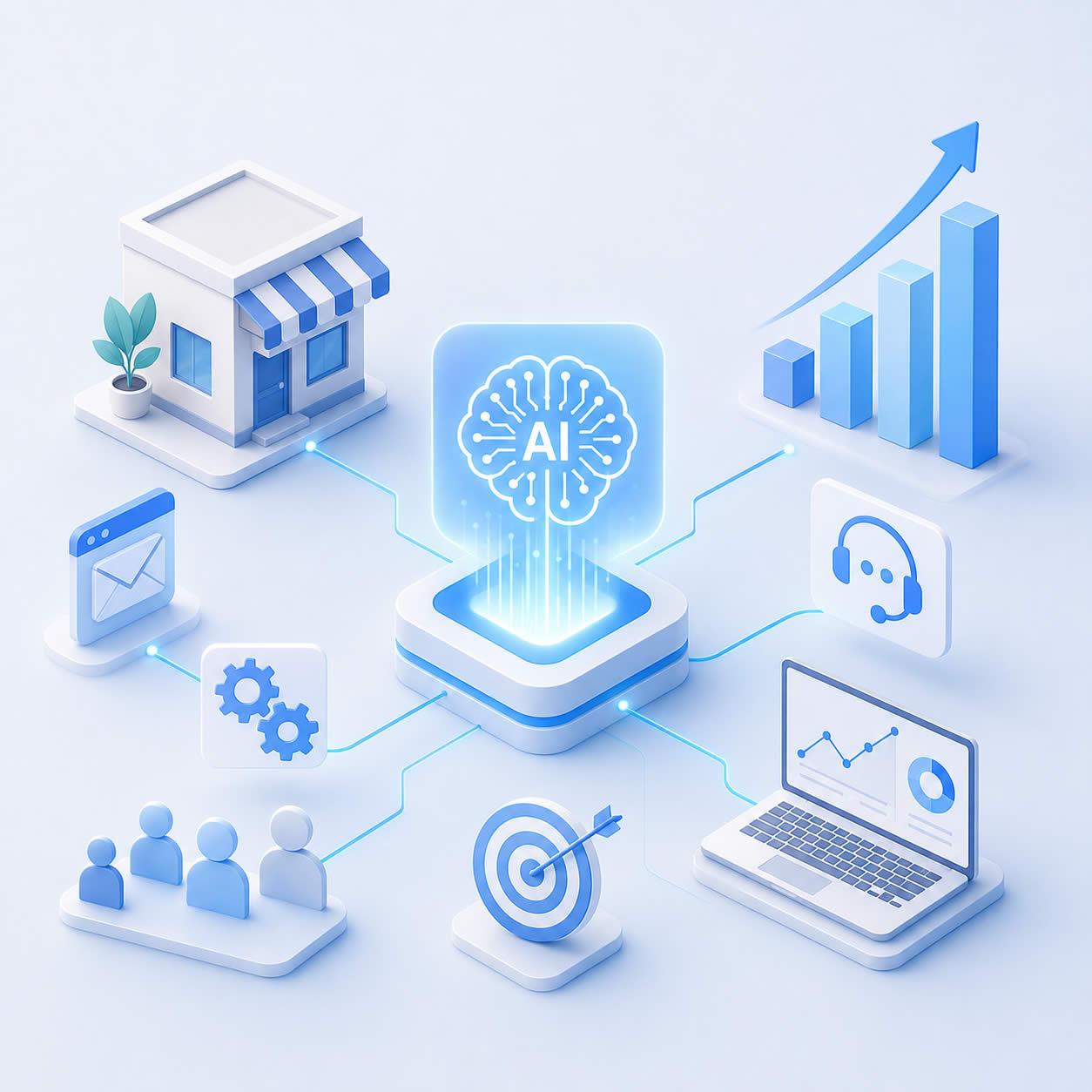
Key Takeaways
- AI allows small businesses to automate repetitive work, giving teams more time to focus on customers and business growth.
- Technologies such as AI Lead Generation, AI Prospecting, Buying Signals, and Intent Data help businesses identify better opportunities without spending hours on research.
- AI SDRs enable businesses to scale sales outreach and lead qualification without significantly increasing headcount.
- AI improves productivity across sales, marketing, customer support, and operations while providing valuable Sales Intelligence and Revenue Intelligence.
- Affordable AI solutions now allow small businesses to compete with much larger organisations by using intelligent automation instead of additional staff.
- KatalystIQ combines AI Sales Automation, Lead Enrichment, AI Outreach, AI SDR, and intelligent revenue tools into one platform designed to help businesses grow predictably.
How AI Helps Small Businesses Grow
Running a small business has never been easy.
Owners wear multiple hats every day. One moment they’re speaking with customers, the next they’re replying to emails, chasing invoices, updating spreadsheets, posting on social media, and somehow finding time to think about growing the business. If coffee had an employee ID, it would probably be named “Senior Operations Manager.”
The challenge isn’t a lack of ambition.
It’s a lack of time, resources, and people.
Unlike large enterprises with dedicated marketing teams, sales departments, analysts, and operations specialists, small businesses often rely on a handful of individuals to keep everything moving. Every hour spent on repetitive administrative work is an hour that isn’t spent serving customers, developing new products, or generating revenue.
This is why artificial intelligence has become one of the most valuable technologies available to growing businesses.
AI is no longer reserved for global corporations with enormous technology budgets. Modern AI platforms are affordable, accessible, and capable of automating many of the repetitive tasks that consume valuable business time. From finding qualified prospects to responding to customer enquiries, analysing sales performance, writing personalised outreach, and identifying businesses that are ready to buy, AI is helping small businesses achieve more without dramatically increasing costs.
Today’s AI combines technologies such as AI Lead Generation, AI Prospecting, AI SDR, Lead Enrichment, Buying Signals, Intent Data, Sales Intelligence, Revenue Intelligence, AI Outreach, and AI Sales Automation to create intelligent workflows that continuously support business growth.
Instead of replacing people, AI acts as an additional member of the team—working around the clock, handling repetitive tasks, analysing data, and helping employees focus on work that genuinely requires human creativity, expertise, and relationship building.
If you’re beginning your AI journey, these guides provide an excellent foundation: What Is AI Lead Generation?, What Is an AI SDR?, 20 Buying Signals Every Sales Team Should Track, How to Write Cold Emails That Get Replies, Lead Scoring & Qualification with AI, What Makes a High-Intent Buyer?, AI for Sales Managers, 10 Proven B2B Lead Generation Strategies, and 17 Common AI Sales Myths Debunked.
In this guide, we’ll explore how AI is helping small businesses overcome growth challenges, automate repetitive work, improve customer engagement, generate qualified leads, increase productivity, and compete with organisations many times their size. You’ll also discover how platforms such as KatalystIQ enable businesses to build a scalable customer acquisition engine without the complexity traditionally associated with enterprise software.
Because growing a business isn’t about working longer hours.
It’s about making every hour work harder for you.
Why Small Businesses Face Unique Growth Challenges
Every business wants to grow.
Small businesses simply have to accomplish that goal with fewer people, tighter budgets, and less margin for error.
Large organisations can often solve problems by hiring additional staff or investing in specialised departments. Small businesses rarely have that luxury. Every new employee represents a significant investment, and every hour spent on administrative work comes at the expense of activities that generate revenue.
Growth therefore becomes a balancing act.
Business owners must continue serving existing customers while simultaneously attracting new ones, improving operations, managing finances, and planning for the future.
Some of the most common challenges include:
- Limited marketing budgets.
- Small sales teams.
- Time-consuming administrative work.
- Inconsistent lead generation.
- Difficulty scaling operations.
- Limited access to business insights.
- Growing customer expectations.
These challenges often create a cycle that is difficult to escape.
When teams become busy serving existing customers, prospecting slows down.
When prospecting slows down, the sales pipeline weakens.
When revenue becomes unpredictable, investing in growth becomes even more difficult.
Artificial intelligence helps break this cycle by automating many of the repetitive activities that consume valuable business time.
Instead of constantly choosing between servicing today’s customers and finding tomorrow’s customers, AI helps businesses do both.
Common Growth Bottlenecks That Hold Small Businesses Back
Most businesses don’t stop growing because demand disappears.
They stop growing because internal capacity reaches its limit.
Growth bottlenecks appear gradually.
At first they seem manageable.
Eventually they become obstacles that affect every department.
Some of the most common bottlenecks include:
- Finding qualified leads consistently.
- Following up with every enquiry.
- Responding quickly to customer questions.
- Managing repetitive administrative work.
- Keeping CRM data accurate.
- Writing personalised sales emails.
- Prioritising the best opportunities.
- Understanding sales performance.
- Scaling operations without hiring.
Many of these tasks aren’t difficult.
They’re simply repetitive.
For example, researching a single prospect might take fifteen minutes.
Researching one hundred prospects every week becomes a full-time job.
The same applies to writing outreach emails, updating CRM records, qualifying leads, scheduling follow-ups, and monitoring potential customers.
Individually, each task appears small.
Together, they consume hundreds of hours every month.
This is exactly where AI creates the greatest value.
Rather than replacing employees, AI removes repetitive work so people can spend more time solving customer problems and building relationships.
What AI Means for Small Businesses
When many business owners hear the term artificial intelligence, they imagine futuristic robots, complicated software, or technology that only multinational corporations can afford.
The reality is far more practical.
For most small businesses, AI is simply another business tool—one that happens to learn, analyse information, and automate repetitive work.
Modern AI can assist with tasks such as:
- Finding qualified prospects.
- Researching companies.
- Performing Lead Enrichment.
- Monitoring Buying Signals.
- Analysing Intent Data.
- Writing personalised emails.
- Scheduling follow-ups.
- Responding to customer enquiries.
- Generating business reports.
- Identifying revenue opportunities.
Instead of expecting employees to manually complete these activities every day, AI performs much of the preparation work automatically.
This enables staff to focus on conversations, strategy, creativity, and customer relationships.
Think of AI less as a replacement for people and more as an exceptionally organised colleague who never forgets a follow-up, never complains about repetitive work, and somehow enjoys analysing spreadsheets.
Platforms such as KatalystIQ combine multiple AI capabilities into a single system, making advanced automation accessible even to businesses without dedicated technical teams.
The result is simple.
Small businesses gain access to capabilities that were once available only to much larger organisations—without needing enterprise-sized budgets.
AI as Your First Digital Employee
Hiring the right employee is one of the biggest investments a small business makes.
Recruitment takes time.
Training takes even longer.
As the business grows, additional hires become necessary—but so do higher salaries, benefits, office space, equipment, and management overhead.
Artificial intelligence offers a different approach.
Instead of immediately expanding headcount, many businesses are deploying AI as their first digital employee.
Unlike traditional software that waits for instructions, AI actively performs work.
It can research prospects, analyse customer behaviour, draft personalised emails, qualify leads, monitor business events, answer customer questions, and recommend next actions—all without constant supervision.
Think of AI as an assistant that works continuously behind the scenes.
It doesn’t replace your salespeople, marketers, or customer support staff.
It prepares much of their work before they even begin.
For example, AI can:
- Research hundreds of companies overnight.
- Identify qualified prospects.
- Monitor Buying Signals.
- Analyse Intent Data.
- Perform Lead Enrichment.
- Recommend priority accounts.
- Generate personalised outreach.
- Prepare follow-up reminders.
The following morning, your sales team begins with a prioritised list of opportunities instead of an empty spreadsheet.
That’s not replacing people.
That’s removing the work that nobody particularly enjoys doing in the first place.
How AI Automates Repetitive Business Tasks
Small businesses often lose valuable time on work that, while necessary, contributes very little strategic value.
Examples include:
- Entering CRM data.
- Updating spreadsheets.
- Scheduling meetings.
- Researching prospects.
- Writing repetitive emails.
- Preparing reports.
- Following up with leads.
- Answering common customer questions.
None of these tasks are particularly difficult.
They’re simply repetitive.
And repetitive work is exactly where AI performs best.
Using AI Sales Automation, businesses can automate many day-to-day operational activities without changing their overall workflow.
AI can automatically:
- Create prospect lists.
- Enrich business records.
- Update CRM information.
- Summarise meetings.
- Generate reports.
- Draft personalised emails.
- Recommend follow-up timing.
- Route enquiries to the appropriate team member.
Automation doesn’t simply save time.
It also improves consistency.
Tasks happen on schedule.
Important follow-ups aren’t forgotten.
Customer enquiries receive faster responses.
The business becomes easier to scale because processes depend less on manual effort.
As workloads increase, AI absorbs much of the repetitive activity, allowing teams to continue growing without proportionally increasing operational complexity.
AI Lead Generation: Finding Better Customers Automatically
Generating qualified leads remains one of the biggest challenges for growing businesses.
Many companies rely on purchased databases, referrals, cold lists, or random online searches.
While these methods can produce opportunities, they are often inconsistent and time-consuming.
AI Lead Generation approaches the problem differently.
Instead of collecting large volumes of contacts and hoping some become customers, AI continuously searches for businesses that closely match your Ideal Customer Profile while also demonstrating signs of purchasing intent.
Modern AI platforms combine:
- AI Prospecting.
- Lead Enrichment.
- Buying Signals.
- Intent Data.
- Sales Intelligence.
This enables businesses to discover opportunities that would be extremely difficult to identify manually.
Rather than spending hours researching companies, AI continuously identifies:
- Businesses entering growth phases.
- Companies hiring rapidly.
- Organisations adopting new technologies.
- Decision-makers matching your target profile.
- Accounts showing strong purchase intent.
Businesses looking to modernise their customer acquisition process can learn more through AI Lead Generation Software and our guide on What Is AI Lead Generation?.
Good lead generation fills a pipeline.
Intelligent lead generation fills it with companies that actually have a reason to buy.
AI SDRs: Growing Sales Without Hiring More Staff
For many small businesses, hiring additional Sales Development Representatives isn’t always financially practical.
Even when budgets allow, recruiting, onboarding, and training new sales staff requires considerable time.
Fortunately, scaling sales no longer depends entirely on growing headcount.
Modern AI SDR platforms perform many of the activities traditionally handled by outbound sales teams.
They continuously:
- Discover qualified prospects.
- Perform Lead Enrichment.
- Monitor Buying Signals.
- Analyse Intent Data.
- Prioritise opportunities.
- Generate personalised outreach.
- Recommend follow-up sequences.
This enables sales representatives to focus on conversations instead of preparation.
Rather than spending hours researching prospects before making contact, representatives receive highly qualified opportunities that are already enriched with relevant business information.
Businesses can therefore increase prospecting capacity without dramatically increasing operational costs.
To learn more about how AI SDRs work, explore What Is an AI SDR? and discover how Lead Machines & AI SDRs help businesses build scalable customer acquisition systems.
For many small businesses, an AI SDR isn’t replacing the first salesperson.
It’s helping the first salesperson perform like an entire outbound team.
AI Outreach: Personalized Emails and Messages at Scale
Most business owners understand that personalised communication performs better than generic sales emails.
The problem is that genuine personalisation takes time.
Researching every company, understanding its business, identifying recent developments, and writing a unique email for each prospect quickly becomes impossible as prospect volumes grow.
This is where AI Outreach changes the equation.
Rather than sending identical templates to hundreds of businesses, AI generates personalised messages based on real business information.
It can reference:
- Recent company growth.
- Hiring activity.
- New product launches.
- Industry trends.
- Technology adoption.
- Relevant Buying Signals.
- Company-specific challenges.
The result is communication that feels researched rather than automated.
AI also helps maintain consistency.
Follow-up emails are sent on time, messaging remains relevant, and prospects continue receiving valuable communication throughout the buying journey.
Businesses wanting to improve outbound engagement should also read How to Write Cold Emails That Get Replies.
Because sending more emails rarely creates better results.
Sending better emails usually does.
Using Buying Signals and Intent Data to Find Customers Ready to Buy
One of the biggest mistakes small businesses make is treating every prospect equally.
Some companies may not require your solution for another year.
Others may already be searching for it today.
The challenge is identifying the difference.
Buying Signals and Intent Data provide exactly that insight.
Buying Signals identify meaningful business events such as:
- Company expansion.
- Hiring activity.
- Funding announcements.
- Leadership changes.
- Technology migration.
- Product launches.
Intent Data reveals what companies are actively researching online.
Together, these technologies help businesses identify organisations that are not only a good fit but are also actively moving toward a purchasing decision.
Rather than contacting hundreds of random businesses, sales teams can prioritise companies showing measurable buying behaviour.
This dramatically improves:
- Response rates.
- Meeting bookings.
- Sales productivity.
- Pipeline quality.
- Forecast accuracy.
Businesses interested in learning more should explore 20 Buying Signals Every Sales Team Should Track and What Makes a High-Intent Buyer?.
Finding customers is good.
Finding customers who are already looking for a solution like yours is considerably better.
AI for Customer Support and Faster Response Times
Customers expect quick responses.
Unfortunately, small businesses can’t always provide twenty-four-hour support with limited staff.
AI helps bridge that gap.
Modern AI assistants can answer common questions, provide product information, qualify enquiries, schedule appointments, and route more complex issues to the appropriate team members.
This creates several benefits:
- Faster response times.
- Improved customer satisfaction.
- Reduced workload for employees.
- Consistent customer experiences.
- Support availability outside business hours.
Rather than replacing customer service teams, AI handles repetitive enquiries so staff can focus on conversations that require empathy, expertise, and problem-solving.
Customers receive quicker answers.
Employees spend less time responding to the same questions every day.
Everybody wins.
AI for Sales Forecasting and Business Intelligence
Growing businesses need more than leads.
They also need visibility.
Business owners make important decisions every day regarding hiring, marketing, inventory, expansion, and investment.
Those decisions become much easier when supported by reliable information.
Artificial intelligence continuously analyses sales performance to provide meaningful Business Intelligence and Revenue Intelligence.
Instead of relying purely on historical reports, AI identifies patterns that help predict future outcomes.
Examples include:
- Sales pipeline health.
- Revenue trends.
- Lead conversion rates.
- Sales forecasting.
- Opportunity prioritisation.
- Customer growth opportunities.
This enables business owners to make better decisions with greater confidence.
Rather than wondering whether next quarter will be busy, AI provides data-driven forecasts based on current customer activity.
While no forecast is perfect, making decisions with intelligent insights is generally preferable to relying solely on crossed fingers and optimistic spreadsheets.
How AI Improves Productivity Across Every Department
One of AI’s greatest strengths is that it isn’t limited to a single department.
Almost every area of a business contains repetitive work that can be improved through intelligent automation.
For example:
- Sales — AI Lead Generation, AI Prospecting, Lead Enrichment, AI SDR, AI Outreach.
- Marketing — content ideas, campaign optimisation, audience segmentation.
- Customer Support — AI chat assistants, ticket routing, automated responses.
- Operations — workflow automation, reporting, scheduling, documentation.
- Leadership — Sales Intelligence, Revenue Intelligence, forecasting, dashboards.
Rather than introducing dozens of disconnected tools, many businesses now prefer unified platforms that combine these capabilities into one system.
KatalystIQ brings together AI-powered prospecting, customer acquisition, sales automation, outreach, analytics, and revenue intelligence to help businesses grow more efficiently.
The greatest productivity gains rarely come from making people work harder.
They come from eliminating work that never needed to be done manually in the first place.
Affordable AI: Why Small Businesses Can Now Compete with Large Enterprises
There was a time when artificial intelligence was available only to organisations with deep pockets, specialist teams, and large IT departments.
That time has passed.
Cloud computing, modern AI models, and software-as-a-service platforms have made AI accessible to businesses of every size.
Today, a small business can access capabilities that were once available only to Fortune 500 companies.
These include:
- AI Lead Generation.
- AI Prospecting.
- AI SDR.
- Lead Enrichment.
- Buying Signals.
- Intent Data.
- AI Outreach.
- Revenue Intelligence.
- Sales Intelligence.
- AI Sales Automation.
The biggest advantage isn’t simply lower cost.
It’s leverage.
Instead of hiring several specialists to perform research, qualification, reporting, and outreach manually, a small team can use AI to accomplish much of the same work in a fraction of the time.
This allows businesses to:
- Scale sales without dramatically increasing payroll.
- Respond to customers more quickly.
- Make better decisions using real-time insights.
- Operate more efficiently.
- Compete with much larger organisations.
Technology has always rewarded businesses that adopt it early.
Artificial intelligence is proving to be no different.
Common Myths About AI for Small Businesses
Despite its growing adoption, many misconceptions still prevent businesses from embracing AI.
Let’s address a few of the most common myths.
- Myth: AI is only for large enterprises.
Reality: Many AI platforms are designed specifically for growing businesses and can be implemented without enterprise-sized budgets. - Myth: AI will replace employees.
Reality: AI automates repetitive work while allowing people to focus on higher-value activities such as customer relationships and strategic planning. - Myth: AI is too complicated to implement.
Reality: Modern AI platforms are significantly easier to deploy than many traditional business systems. - Myth: AI produces generic communication.
Reality: Modern AI uses company-specific information, Buying Signals, and Intent Data to create highly personalised outreach. - Myth: AI is only useful for technology companies.
Reality: AI is helping businesses across healthcare, finance, manufacturing, recruitment, real estate, agencies, professional services, and many other industries.
If you’d like a deeper discussion of these misconceptions, see our article 17 Common AI Sales Myths Debunked.
The businesses gaining the greatest advantage from AI aren’t necessarily the largest.
They’re the ones willing to embrace smarter ways of working.
Best Practices for Successfully Adopting AI
Implementing AI successfully doesn’t begin with buying software.
It begins with understanding where your business loses the most time.
The most successful AI projects usually start with one repetitive process before expanding gradually across the organisation.
Some best practices include:
- Start with one clearly defined business problem.
- Automate repetitive work before complex processes.
- Maintain accurate customer and prospect data.
- Define your Ideal Customer Profile.
- Combine AI with existing business workflows.
- Measure improvements regularly.
- Train employees to work alongside AI.
- Continuously optimise based on results.
AI should become part of the way your business operates—not another disconnected tool that employees forget exists after two weeks.
The goal isn’t to automate everything.
The goal is to automate the right things.
How KatalystIQ Helps Small Businesses Build a Predictable Growth Engine
KatalystIQ was built to help businesses grow without adding unnecessary complexity.
Instead of managing separate tools for prospecting, enrichment, outreach, analytics, and sales automation, businesses can manage their customer acquisition strategy from a single intelligent platform.
KatalystIQ combines:
- AI Lead Generation.
- AI Prospecting.
- Lead Enrichment.
- Buying Signals.
- Intent Data.
- AI SDR.
- AI Outreach.
- Sales Intelligence.
- Revenue Intelligence.
- AI Sales Automation.
It also learns your products, services, messaging, and Ideal Customer Profile through AI Learns Your Business, allowing every recommendation and outreach campaign to become increasingly relevant over time.
Businesses can further accelerate implementation through KatalystIQ Velocity, our premium AI growth service.
Velocity helps organisations deploy AI successfully through strategy workshops, platform configuration, CRM integration, custom Lead Machines, outreach automation, workflow optimisation, and ongoing expert guidance.
The result is a predictable customer acquisition engine that continuously discovers, qualifies, prioritises, and engages new business opportunities.
Real-World Examples of AI Helping Small Businesses Grow
AI is delivering measurable improvements across a wide range of industries.
Examples include:
- A recruitment agency automatically identifies companies actively hiring and prioritises outreach using Buying Signals.
- A manufacturing supplier discovers expanding businesses using AI Prospecting and Lead Enrichment before competitors identify them.
- A professional services firm uses AI SDRs to generate personalised outbound campaigns while consultants remain focused on client delivery.
- A software company combines Intent Data with AI Outreach to engage prospects actively researching competing solutions.
- A financial services provider uses Revenue Intelligence to improve forecasting and identify cross-selling opportunities.
Although every business is different, the pattern remains remarkably consistent.
Businesses that automate repetitive work gain more time to focus on customers, innovation, and growth.
Future Trends: AI Will Become Every Small Business’s Competitive Advantage
Artificial intelligence is still evolving rapidly.
Over the next few years, AI will become even more proactive.
Instead of simply responding to business activity, AI will increasingly predict future opportunities and recommend actions before owners even realise attention is required.
Future capabilities are likely to include:
- Predictive lead generation.
- Smarter AI SDRs.
- Autonomous workflow automation.
- Real-time customer intelligence.
- Predictive revenue forecasting.
- Hyper-personalised AI Outreach.
- Continuous optimisation of sales and marketing campaigns.
Businesses that begin building AI-powered processes today will be significantly better positioned to benefit from these future capabilities.
Conclusion
Growing a small business has always required creativity, persistence, and the ability to achieve more with limited resources. Artificial intelligence doesn’t change those fundamentals. It simply gives business owners better tools to overcome the operational challenges that often limit growth.
By combining AI Lead Generation, AI Prospecting, Lead Enrichment, Buying Signals, Intent Data, AI SDR, AI Outreach, Sales Intelligence, Revenue Intelligence, and AI Sales Automation, businesses can automate repetitive work, identify better opportunities, engage customers more effectively, and make smarter decisions using real-time insights.
KatalystIQ brings these capabilities together into a single intelligent growth platform designed specifically to help businesses build predictable customer acquisition systems. Combined with KatalystIQ Velocity, organisations gain both advanced AI technology and experienced guidance to successfully deploy it across sales, marketing, and operations.
The future won’t belong to the businesses with the largest teams. It will belong to the businesses that make the smartest use of technology. For small businesses willing to embrace AI today, that future has already begun.
Frequently Asked Questions
AI helps small businesses grow by automating repetitive work, improving lead generation, enhancing customer service, and providing valuable business insights. Technologies such as AI Lead Generation, AI SDR, AI Outreach, and AI Sales Automation allow businesses to accomplish more without significantly increasing headcount. This enables owners and employees to focus on strategy, customer relationships, and revenue-generating activities.
Yes. Modern AI platforms are available through affordable subscription models, making advanced technology accessible to businesses of all sizes. Small businesses no longer need dedicated AI teams or enterprise-sized budgets to benefit from automation. In many cases, AI delivers a return on investment by reducing manual work and increasing sales productivity.
No. AI is designed to support employees rather than replace them. It handles repetitive activities such as research, data entry, reporting, and initial customer engagement, allowing people to focus on creative work, relationship building, and business growth. The most successful businesses use AI as a productivity tool alongside their existing teams.
AI Lead Generation uses artificial intelligence to automatically identify businesses that match your Ideal Customer Profile and demonstrate signs of purchasing intent. Rather than relying on static prospect lists, AI continuously discovers qualified opportunities using Lead Enrichment, Buying Signals, and Intent Data. This improves lead quality while reducing manual prospecting effort.
AI SDR platforms automate many of the activities traditionally performed by Sales Development Representatives. They discover prospects, qualify leads, monitor Buying Signals, generate personalised outreach, and recommend follow-up actions. This allows small sales teams to increase prospecting capacity without hiring additional staff.
Buying Signals are business events that indicate a company may be preparing to purchase a product or service. Examples include hiring, expansion, funding announcements, leadership changes, and technology adoption. Monitoring these signals allows businesses to contact prospects when purchasing intent is strongest, resulting in higher conversion rates.
Intent Data measures the online research behaviour of companies as they investigate products, services, or industry topics. It helps identify organisations that are actively evaluating solutions before they contact vendors directly. Combined with Buying Signals, Intent Data significantly improves sales prioritisation and outreach effectiveness.
AI enables businesses to respond to customer enquiries faster through intelligent assistants, automated workflows, and conversational AI. It can answer frequently asked questions, qualify enquiries, route requests to the appropriate team members, and provide support outside normal business hours. This improves customer satisfaction while reducing the workload on support teams.
KatalystIQ combines AI Lead Generation, AI Prospecting, Lead Enrichment, Buying Signals, Intent Data, Sales Intelligence, Revenue Intelligence, AI SDR, AI Outreach, and AI Sales Automation into a single platform. It continuously identifies qualified opportunities, prioritises prospects, automates outreach, and provides actionable business insights that help businesses build predictable growth.
The best approach is to start with one business challenge that consumes significant time, such as lead generation, customer support, or sales outreach. Implement AI gradually, measure the results, and expand automation as the business becomes more comfortable with the technology. A focused approach typically delivers faster adoption, better employee acceptance, and a stronger return on investment.