

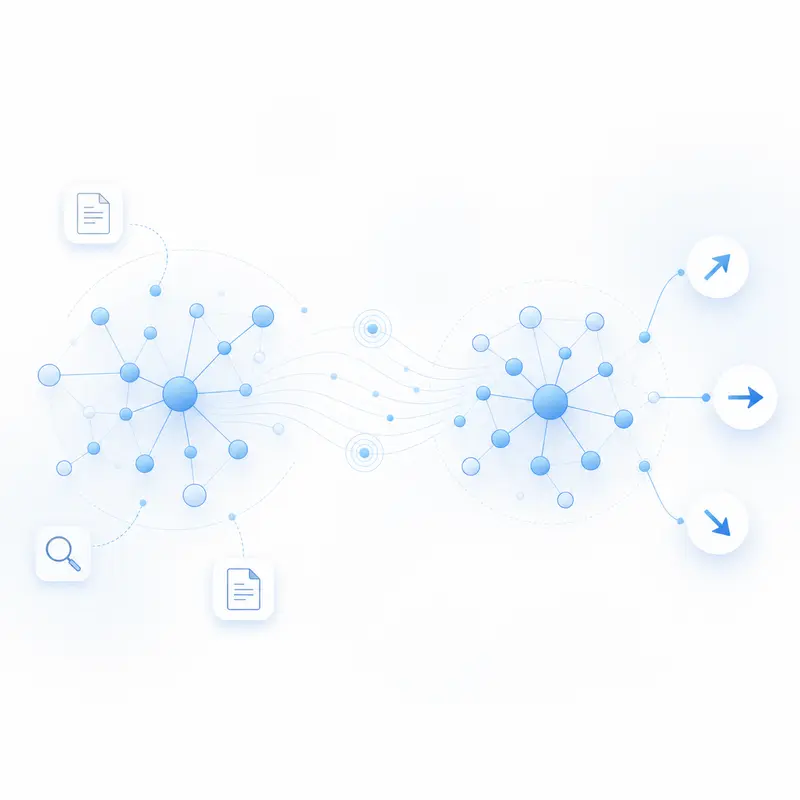
Intent Data vs Buying Signals: Quick Answer
Intent data captures research behavior that suggests an account is exploring a topic or solution category, often sourced from websites, publishers, and ad networks across the web. Buying signals capture actions tied directly to your brand and product—such as demo requests, trial activations, and pricing-page visits—that indicate readiness to engage with sales.
Core difference: intent data is largely external and appears earlier in the buyer journey (problem research), while buying signals are first-party and surface later (solution shortlisting and vendor selection).
When to use intent data: identify in-market accounts, inform ABM targeting, and personalize campaigns by topic. When to prioritize buying signals: trigger SDR outreach, fast-track qualification, and route leads with high urgency to sales.
Recommendation: for most B2B teams, use intent data to decide which accounts to prioritize and what to say, and use buying signals to decide who gets real-time outreach and how aggressively to follow up.
What Is Intent Data?
Intent data refers to digital breadcrumbs that indicate an account is researching a topic relevant to your solution. It can originate from several sources:
- First-party: activity on your own properties (website searches, resource downloads, webinar engagement, chat interactions). This is the most controllable and attributable.
- Second-party: another company’s first-party data shared directly with you (for example, a publisher or review site sharing topic consumption at the account level under contract).
- Third-party: aggregated signals from across many sites and networks (topic surges, keyword clusters, content consumption patterns) typically resolved to an account via IP, domain, or device graphs.
Common behavioral signals include topic and keyword searches, content consumption on relevant articles, ad engagement, review-site category views, and publisher-level “surge” alerts for IP or domain cohorts.
Collection methods, latency, and coverage
- Collection: pixel/event tracking, log files, IP-to-company resolution, and modeled cohorts from content networks.
- Latency: anywhere from hours to weeks depending on the provider’s refresh rate and normalization. Third-party data often has more lag than first-party.
- Coverage: varies by region, industry, company size, and browsing environment (privacy settings, cookie restrictions, VPNs). Many datasets resolve to the account, not the individual contact.
Signal granularity, scoring, and enrichment
- Granularity: typically account-level topics with intensity scores; first-party can reach user-level events if consent and identity resolution exist.
- Scoring: blend recency, frequency, and volume (RFV) with topic weights. Many teams set baseline activity by industry and flag statistical “surges” above normal.
- Enrichment: attach firmographics (industry, size), technographics, and CRM identifiers to match accounts and de-duplicate. Add contact discovery only after legal review and consent controls.
Strengths and limitations
- Strengths: earlier visibility into market interest, broader top-of-funnel coverage, category-level insights to shape messaging and content. Useful to prioritize territories and ABM plays.
- Limitations: noise and false positives (e.g., student research, vendor competitors), attribution challenges (who exactly is researching), and black-box methodologies. Privacy and cookie restrictions can reduce reliability or timeliness.
How KatalystIQ helps
If you use intent data, you need it operationalized. KatalystIQ can ingest first-party web events and third-party intent feeds via integrations, enrich accounts, apply customizable scoring, and route qualified accounts into workflows—so marketing knows which topics to personalize and sales knows which accounts to monitor.
What Are Buying Signals?
Buying signals are observable behaviors tied to your brand, product, or target accounts that indicate purchase readiness. They break into two categories:
- Explicit signals: direct hand-raises such as demo requests, trial activations, RFP/RFI submissions, pricing-contact forms, event meeting bookings, and “talk to sales” chats.
- Implicit signals: behaviors correlated with intent that do not explicitly ask for sales, such as repeat visits from the same account, deep product-page views, multiple pricing-page sessions, high-intent content sequences (e.g., case study → ROI calculator → security page), and product usage telemetry during a trial.
Examples of seller-observed implicit signals
- Website: repeated visits from the same company network, high scroll depth on comparison pages, return visits to integration docs, or frequent visits to the security/compliance center.
- Product: trial account activates multiple features, invites teammates, connects integrations, or hits capacity thresholds.
- Engagement: email replies, meeting acceptances, proposal views, e-signature opens, or chatbot conversations about timelines and budget.
How systems generate buying signals
- Sales and CRM: stage changes, tasks completed, meeting outcomes, quote creation, and forecast notes can all represent rising intent.
- Product analytics: feature-adoption milestones, POC success criteria met, or error-resolution events indicate readiness or urgency.
- Marketing automation: lead score spikes from multi-channel engagement, webinar attendance with Q&A participation, and post-event survey responses.
Reliability and actionability
Compared with third-party intent data, buying signals are closer to revenue because they are first-party, attributable, and often contact-level. They typically warrant immediate action: alert the SDR, accelerate qualification, or trigger a tailored follow-up sequence. The trade-off is narrower reach—these signals appear once an account is already engaged with you.
How KatalystIQ helps
KatalystIQ continuously monitors first-party engagement and public company-event cues (such as hiring activity, funding announcements, technology changes, leadership moves, and site updates) that often correlate with purchase readiness. It turns these signals into prioritized queues, alerts, and personalized outreach, so teams act quickly when intent becomes actionable.
Key Differences Between the Two
Ownership and trustworthiness
- Intent data: frequently vendor-sourced and modeled. Useful for discovery but can carry ambiguity about which individuals are researching and why.
- Buying signals: captured by your own systems (website, product, CRM, sales engagement). Higher attribution confidence and auditability.
Timing and lead window
- Intent data: earlier-stage signals during problem exploration and solution research; good for shaping messaging and initiating warm awareness.
- Buying signals: later-stage or near-sales signals when a prospect is shortlisting or testing; ideal for triggering fast outreach and tailored proposals.
Specificity and signal-to-noise
- Intent data: often account-level and topic-based; helpful for prioritization but susceptible to false positives and shared-IP artifacts.
- Buying signals: contact-level or verified account interactions; higher precision and actionability, though they appear for a smaller subset of the market at any moment.
Sales urgency and marketing tactics
- Intent data: favors marketing-led ABM, content personalization, and research plays (e.g., “send the cloud-cost benchmarking guide to accounts surging on ‘FinOps’”).
- Buying signals: favors sales-led action—instant alerts, SDR call tasks, one-to-one emails, POC support, and executive outreach.
Brief examples
- Intent data example: multiple companies in your ICP show a two-week surge in “data governance platform” topics. Marketing launches a targeted ad and email sequence, updates SDR talk tracks, and warms those accounts before outreach.
- Buying signal example: a target account’s VP of Engineering requests a trial, invites five engineers, connects your integration, and the same account visits your pricing page twice. SDR gets an alert, prioritizes a discovery call today, and sales accelerates a tailored proof of value.
Putting it to work with KatalystIQ
Teams often use both simultaneously: import third-party B2B intent signals to decide which accounts to watch, and configure KatalystIQ to trigger real-time SDR alerts when those same accounts exhibit buying signals on your site or in your product. This combination raises coverage early and precision late without overwhelming sales with noise.
How They Complement Each Other
Treat intent data and buying signals as two lenses on the same account: one wide-angle, one zoom. A practical approach is to combine them in a unified scoring and workflow system so marketing can warm the ground early while sales acts decisively when high-fidelity cues appear.
-
Combined scoring models: Start with an account-level intent score (topics researched, content categories, publisher surges) and add person-level buying signal points (pricing page views, trial activations, demo requests). Weight by reliability and proximity to purchase. For example, you might score a model like: Account Intent (0–100) x 0.4 + Contact Buying Signals (0–100) x 0.6, with recency decay. Calibrate weights using historical conversion-to-opportunity rates. Many teams begin with a points model, then evolve to a statistical or ML model after collecting enough labeled outcomes.
-
Workflow alignment: Use early intent to run research and content plays; use later buying signals to trigger SDR outreach. Marketing can launch account-targeted ads, send topic-specific content, and alert BDRs to map the buying group. When a buying signal appears (e.g., repeat pricing views, RFP submission), switch to directly attributable outreach and meeting setting.
-
Enrichment and match rates: The more precisely you match a signal to a real account and contact, the more valuable it becomes. Firmographic enrichment (industry, employee count, geo, tech stack) and strong identity resolution (domain normalization, role/title mapping) lift match rates and filter out poor-fit surges. This is essential for ABM where precision matters.
-
Reducing false positives: Require corroboration. For example, only activate sales when an in-market account (intent) also exhibits a qualifying in-bound or product-behavior event (buying signal). Add recency windows (e.g., signals within 14 days), ICP filters, and role checks to minimize noise.
-
Sequence-based plays that use both:
1) Surge-to-education: Account intent spike on “data residency” → 7-day content sequence to buying group → if pricing or integration docs are viewed twice in 10 days, create SDR task with a talk track about compliance.
2) Competitor-switch: Third-party research on migration topics + new hiring of a platform admin → ads featuring migration guides → when a contact downloads the guide and visits pricing, trigger AE-led discovery outreach.
3) Event momentum: Topic surge around your category the week before a conference → invite relevant contacts to your session → if they scan your booth QR or activate a trial onsite, immediately route to a fast-lane meeting cadence.
KatalystIQ can operationalize this pairing by unifying intent and buying signals, enriching accounts, scoring opportunities, and automating the switch from content plays to SDR outreach. Its AI Lead Qualification and Workflow Automation help apply decays, thresholds, and routing without manual spreadsheet work.
Common Use Cases and Workflows
-
Lead prioritization and dynamic routing: Rank daily work for SDRs by a combined intent-and-buying-signal score. Define thresholds such as “AQL” (Account Qualified Lead) for accounts surging on target topics and “HQL” (Highly Qualified Lead) when a contact shows strong buying signals. Route by territory and seniority; send hot accounts to AEs, and research-needed accounts to SDRs. KatalystIQ can push prioritized alerts into your CRM and assign owners based on rules you set.
-
ABM targeting and ICP expansion: Use B2B intent signals to identify net-new accounts researching adjacent problems you solve. Add firms with surges on specific topics, recent funding, or hiring patterns to your 1:1 or 1:few ABM programs. Validate expansion by overlaying firmographics and technology fit before investing in bespoke plays. KatalystIQ’s Lead Machines can continuously watch for these triggers and queue accounts for ABM.
-
Campaign personalization and content sequencing: Map observed intent topics to modular email and ad content. If an account is consuming content about “security automation,” prioritize case studies and integration guides over high-level blogs. When a contact triggers a buying signal, pivot to ROI calculators and implementation timelines. KatalystIQ’s AI Personalization can generate targeted messages grounded in each prospect’s signals and firmographics.
-
Real-time sales alerts and playbooks from buying signals: Create alerts when a prospect starts a trial, revisits pricing, invites new users, or views a shared proposal. Launch a coordinated play: SDR same-day outreach, AE invite for technical deep dive, automated email with relevant FAQs, and a calendar link. With KatalystIQ, these alerts and multi-channel steps can be orchestrated via no-code workflows and executed by an AI SDR if desired.
-
Cross-sell and expansion: Watch product telemetry, hiring spikes in relevant teams, or leadership changes to uncover expansion potential. Example: a jump in seat provisioning coupled with a new regional office → trigger an AE expansion call and a targeted in-app nudge. KatalystIQ’s Buying Signals Detection tracks company expansion, leadership changes, and tech changes to surface timely cues.
-
Churn risk and retention: Monitor downward shifts in product usage, support sentiment spikes, or third-party intent toward competitors. When detected, launch a save play: CSM outreach, usage review, and tailored enablement content. KatalystIQ workflows can flag these risks early so customer teams can prioritize intervention.
Measuring Accuracy and ROI
A disciplined measurement plan prevents “signal theater.” Anchor your program on a few core metrics, test design, and reporting habits.
-
Key metrics:
• Match rate: percent of raw signals that resolve to valid ICP accounts/contacts in your CRM.
• Precision: percent of activated signals that progress to a qualified stage (e.g., Stage 2 opportunity) within a set window.
• Conversion uplift: lift in meeting rate, opportunity creation, or win rate versus a control without signal activation.
• Pipeline influenced: qualified pipeline dollars from signal-activated accounts, tracked with clear attribution rules.
• Time-to-close: median days from first activation to closed-won compared to baseline. -
A/B and holdout testing:
• Randomize at the account level to avoid contamination across contacts in the same company.
• Holdout group: receives business-as-usual plays; Test group: receives signal-activated plays.
• Run tests for at least one full sales cycle; measure leading (meetings, stage progression) and lagging (revenue) indicators.
• Use staggered starts or stepped-wedge designs if you need to roll out by segment while keeping a valid comparison. -
Calculating ROI and cost per converted account:
• Incremental revenue = (Revenue from Test) – (Revenue from comparable Holdout).
• Program cost = data + tools + ops + incremental SDR/AE time.
• ROI = (Incremental revenue – Program cost) / Program cost.
• Cost per converted account = Program cost / Number of accounts that reached your defined conversion stage due to the program.
• If revenue is long-cycle, use incremental qualified pipeline with a conservative expected conversion rate. -
Signal decay and refresh cadence:
• Apply a time-to-live (TTL) per signal type (e.g., 7–14 days for topic surges; 1–3 days for pricing views).
• Use recency weighting and cap frequencies to avoid over-scoring stale or repeated touches from the same user.
• Track average “time from signal to action” and its impact on precision; slower follow-up usually lowers yield. -
Recommended diagnostic reports and dashboards:
• Intent-to-meeting by topic and segment.
• Alert-to-first-touch SLA and its correlation with opportunity rate.
• Precision and false-positive rate by signal source and channel.
• Opportunity stage progression curves for activated vs. control accounts.
• Coverage and match rate across your ICP tiers and territories.
• Contribution analysis: top decile of scores vs. rest on pipeline and wins.
KatalystIQ can tag each signal with source, timestamp, TTL, and score in your CRM, making it easier to build the above dashboards. Its workflows can also automate holdouts, enforce SLAs, and record outcomes so you have clean data for ongoing optimization.
Implementation: From Signals to Sales Actions
-
Design the data ingestion and enrichment pipeline: Identify feeds for first-party events (web analytics, product telemetry, emails), second/third-party intent sources, and firmographic enrichment. Normalize domains, resolve identities at account and contact levels, deduplicate, and store raw plus standardized fields. Respect consent and privacy gates throughout the pipeline. KatalystIQ supports ingestion via APIs, webhooks, and native integrations, and enriches leads with firmographics and context.
-
Map signals to CRM fields and stages: Create an account-level intent object (lastintenttopic, intentscore, intentttl) and a contact-level buying-signal object (signaltype, lastsignalat, signalstrength). Add derived fields like combinedscore, activationstatus, and nextbestaction. Tie these to your lead, contact, account, and opportunity records so sales can see context in one place.
-
Build and validate a multivariate scoring model: Start with a transparent points model that weights signal type, fit, and recency. Add hysteresis to prevent score “flapping” (e.g., require two consecutive days above threshold before triggering). Validate on historical data; set thresholds for marketing-ready, AQL, and hot-lead states based on desired precision and sales capacity. As data accumulates, consider moving to ML models, but keep explainability for frontline adoption.
-
Implement real-time alerts, routing rules, and playbooks: Define what triggers an alert, who gets it, how fast, and what they do. Examples: “Two pricing views within 3 days” → SDR task + same-day email template + 3-step LinkedIn sequence; “Topic surge + new VP hire” → add account to ABM 1:1 track with executive outreach. Route by territory, industry, and account tier; suppress duplicates. With KatalystIQ, you can build these rules in no-code workflows, trigger multi-channel outreach, and let an AI SDR run initial touches.
-
Establish monitoring, feedback, and retraining: Log outcomes to label your data (meeting set, qualified, no fit). Review weekly: precision by signal/source, SLA adherence, and rep feedback on talk tracks. Rebalance weights quarterly, refresh decay windows, and update playbooks as patterns change. KatalystIQ’s automation and integrations simplify capturing outcomes and feeding them back into scoring. If you need hands-on support, KatalystIQ Velocity can help design data models, build Lead Machines, and tune workflows for your motion.
This end-to-end approach turns the intent data vs buying signals debate into a practical system: early signals guide where to invest, later signals dictate when and how to act—continuously, and at scale.
Choosing Vendors and Tools
Evaluating vendors for intent and buying-signal data is a technical and commercial exercise. Treat it like any other data supply chain decision: define the use cases, pressure-test data quality, validate integrations, and run a timeboxed pilot before you scale.
Vendor evaluation criteria:
-
Data freshness and latency: How quickly new signals appear (minutes vs. days) and how often aggregates refresh.
-
Coverage: Industries, regions, company sizes, languages, and the share of your ICP the vendor can actually observe.
-
Source transparency: What sources are used, how signals are collected, and whether consent provenance is available.
-
Identity resolution: How anonymous activity is mapped to accounts/contacts (IP-to-company, login, email hash) and expected match rates.
-
Signal quality controls: Confidence scoring, de-duplication, bot filtering, and topic taxonomy clarity.
-
Compliance posture: Consent capture, lawful basis documentation, opt-out mechanisms, and support for data-subject requests.
-
Integration depth: Native CRM/marketing automation connectors, APIs, webhooks, batch exports, and support for custom objects/fields.
-
Operational fit: Alerting, routing, role-based access, sandbox environments, and troubleshooting visibility (logs, reason codes).
Differences between vendor categories:
-
Intent-platform vendors: Aggregate third-party signals (topic consumption, publisher activity, search trends) to show account-level research spikes. Useful early in the buying journey for ABM targeting and content orchestration; typically noisier, requires scoring.
-
Event-stream providers: Deliver raw external events (e.g., hiring moves, funding, tech-stack changes, website updates) in near real time. Highly flexible and timely, but you must craft the rules and filters to separate noise from action.
-
Buying-signal tools: Capture first-party actions on your properties and products (web visits, pricing page views, trial usage, CRM status changes). Highest trust and actionability, but limited to known traffic/users and your owned channels.
Shortlisting and pilot checklist:
- Define the use cases: ABM targeting, SDR prioritization, churn prevention, or expansion plays. Document the exact triggers you need (e.g., “topic spike in data governance” + “visited pricing page”).
- Provide a test corpus: 100–300 target accounts across segments. Ask for 8–12 weeks of backfill to evaluate recall and consistency.
- Run sample queries: Topic clusters relevant to your ICP (e.g., cloud cost management, data quality, zero-trust architecture). Inspect false positives and missed accounts.
- Instrument success criteria: Match rate, precision (manual spot checks), meeting rate uplift, pipeline influenced, time-to-first-touch, alert latency, and API uptime during the pilot.
- Validate integrations: Map signals to CRM account/lead fields, confirm routing rules, verify deduplication, and simulate edge cases (mergers, domain changes).
- Decide operational thresholds: Minimum confidence/volume required to trigger outreach; suppression rules; decay windows.
- Review compliance docs: DPA, subprocessor list, consent provenance, data retention, and opt-out workflows.
Pricing model trade-offs:
-
Per-record/credit: Pay only for what you use; budgeting becomes variable and can spike with volume.
-
Subscription: Predictable cost and broad access; risk of overpaying if usage is light and of hitting rate limits if heavy.
-
Outcomes-based: Aligns cost to meetings/opportunities; requires clear attribution, data sharing, and tight definitions to avoid disputes.
-
Hybrids: Common in practice; scrutinize overage rules, refresh cadence included, and webhook/API rate limits.
Integration capabilities and production SLAs to expect:
-
Data flows: Streaming webhooks for real-time alerts; batch exports for analytics; bi-directional APIs for updates and enrichment.
-
CRM/marketing support: Standard objects (Account, Lead, Contact, Opportunity), custom fields, campaign associations, and sandbox support.
-
Identity and consent fields: Storage for confidence scores, consent status, source provenance, and event timestamps.
-
Security and reliability: Clear uptime commitments, incident communication processes, bounded delivery latency (expressed in minutes), defined refresh cadences (days/weeks), and target response times for support.
KatalystIQ can simplify this selection by unifying multiple signal types—first-party buying signals, external event monitoring, enrichment, scoring, and multi-channel outreach—within one platform. Teams often run a focused pilot in KatalystIQ, wiring signals to CRM fields, defining thresholds, and activating AI-personalized plays to validate fit before broader rollout.
Privacy, Compliance and Data Quality Risks
Signal-driven selling only works when the data is lawful, respectful of user choices, and accurate enough to inform action. Treat privacy and quality as design constraints rather than afterthoughts.
GDPR, CCPA and consent considerations (high level, not legal advice):
-
Lawful basis and transparency: Be clear about what data you collect and why. If you rely on cookies or tracking, obtain consent where required and document it.
-
Data minimization and purpose limitation: Collect only what you need and use it for declared purposes (e.g., lead qualification, ABM targeting).
-
Rights and opt-outs: Support subject requests and opt-outs, and propagate them through your vendor ecosystem.
-
Aggregated vs. personal data: Account-level aggregates from public or consented sources may have different obligations than personal identifiers; confirm with counsel.
Technical limits and vendor responsibilities:
-
Cookies and headers: Third-party cookies are restricted in many environments; respect consent banners and avoid browser fingerprinting.
-
IP-to-company and device matching: Treat these as probabilistic; keep confidence scores and avoid over-personalizing on weak matches.
-
Consent provenance: Require vendors to document source, timestamp, and scope of consent, and to honor revocations.
-
Data quality pitfalls and mitigations:
-
Bots and automation: Use vendor bot filtering plus your own controls (e.g., exclude known bot user agents, non-human session patterns).
-
Sampling bias: Some industries, geos, or networks are over/underrepresented. Monitor segment-level match rates and adjust your expectations.
-
False positives and misattribution: Corroborate with at least one additional signal before triggering high-effort outreach; maintain decay windows and suppression lists.
-
Stale firmographics or identity drift: Refresh core attributes on a set cadence; handle domain changes and M&A with reconciliation rules.
Governance practices that keep you safe and effective:
-
Assign data owners: Marketing ops or RevOps should own signal schemas, thresholds, and audits.
-
Establish a review cadence: Quarterly vendor audits, monthly quality spot-checks, and regular threshold tuning based on outcomes.
-
Maintain artifacts: DPAs, subprocessor inventories, data maps, and runbooks for incident handling and subject requests.
-
Version control for scoring: Track changes to models and thresholds; evaluate impact using holdouts before global rollout.
Your CRM should be the system of record for consent flags and suppression logic, with signals appended and governed through consistent field mappings. Platforms like KatalystIQ integrate with CRMs and workflow tools so you can operationalize consent-aware routing and decay rules without manual effort.
Frequently Asked Questions
Intent data vs buying signals comes down to source and timing: intent data is typically third-party or aggregated research behavior that surfaces earlier in the journey, while buying signals are first-party, high-fidelity actions on your assets (e.g., trials, pricing views) that indicate late-stage readiness.
Yes—start lightweight: define a narrow ICP, subscribe to a few high-relevance topics or event types, and route only the highest-confidence accounts to outreach while testing lift with simple holdouts.
Use intent to select and warm accounts with tailored content and ads, then escalate when buying signals appear—pricing views, demo requests, or product usage—triggering SDR outreach and tighter, persona-specific messaging.
Buying signals generally drive faster conversion because they reflect direct engagement; use intent data to prioritize and personalize research, then act when a buying signal crosses your threshold.
Accuracy varies by source coverage and identity resolution; treat it as directional. Improve precision by corroborating with first-party behavior, applying confidence thresholds, and using decays and suppression rules.
Ensure lawful basis and consent where required, minimize personal data, honor opt-outs, and demand vendor transparency about sources, consent provenance, retention, and subprocessors.
Run a controlled pilot with a holdout group: measure uplift in connect rate, meeting rate, qualified pipeline, and time-to-first-touch while monitoring match rate, precision, and alert latency.
No—buying signals should enrich and rebalance your scoring model, not replace it; combine firmographics, fit, intent, and buying behavior with clear thresholds that map to specific sales actions.