

Key Takeaways
- Focus on quality over quantity by defining a clear Ideal Customer Profile (ICP) before starting any prospecting campaign.
- Combine multiple prospecting channels—including email, LinkedIn, phone, referrals, and content marketing—to maximize reach and engagement.
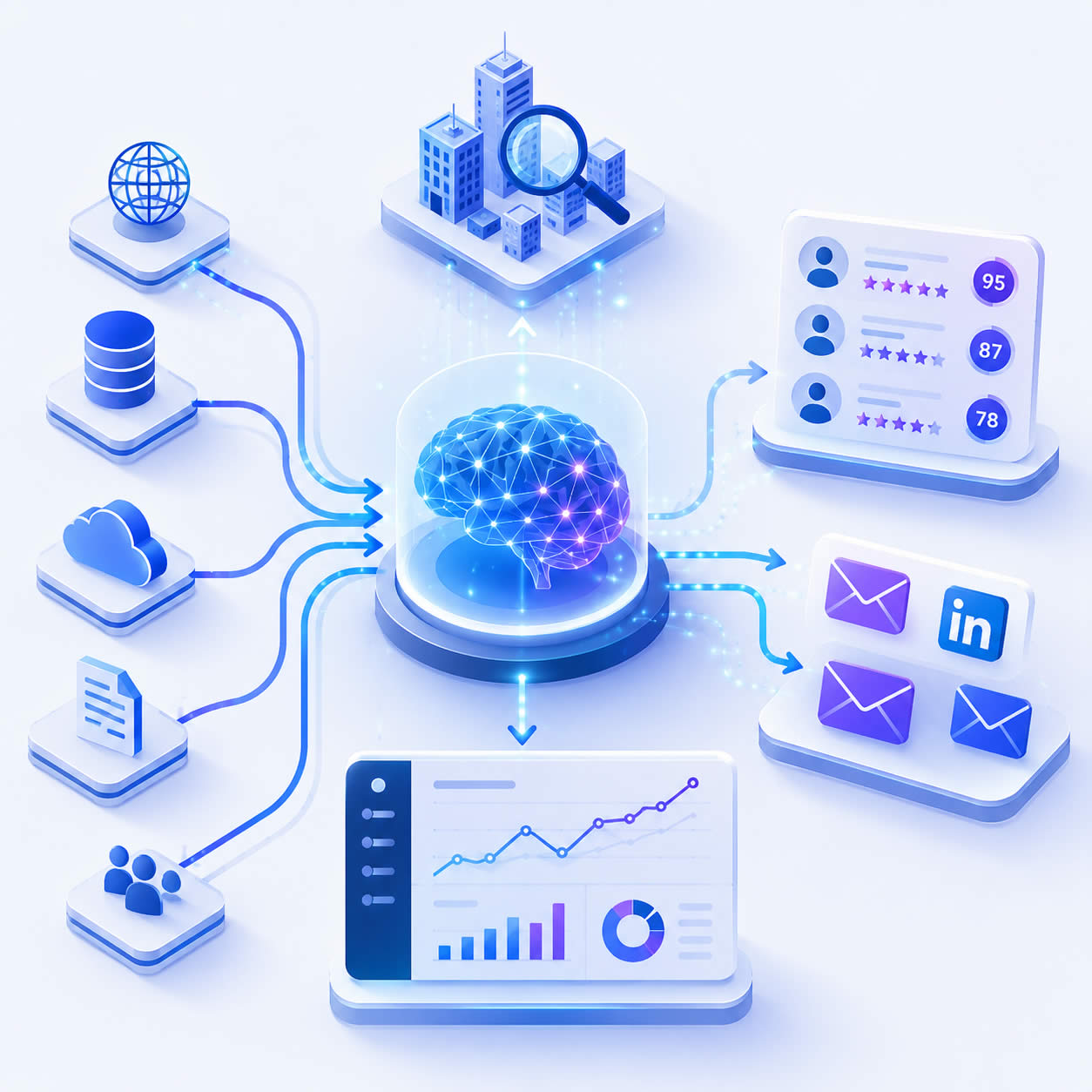
- Use AI-powered tools for prospect research, Lead Enrichment, AI Outreach, and AI Sales Automation to improve efficiency.
- Align sales and marketing teams around shared goals, messaging, and lead qualification criteria to improve conversion rates.
- Offer valuable lead magnets and educational content that solve real business problems instead of pushing sales too early.
- Platforms like KatalystIQ simplify modern B2B prospecting by combining AI Prospecting, Buying Signals, Revenue Intelligence, and AI SDRs into a single workflow.
10 Proven B2B Lead Generation Strategies That Work in 2026
Every B2B business faces the same challenge sooner or later—finding enough qualified prospects to keep the sales pipeline healthy. The irony is that there has never been more business data available, yet many sales teams still struggle to identify the right companies, reach decision-makers, and convert conversations into customers. The problem isn’t a lack of opportunities. It’s knowing where to look, who to contact, and when to engage.
Traditional prospecting methods still have their place, but relying solely on purchased contact lists, generic cold emails, or endless spreadsheet research is becoming increasingly inefficient. Buyers expect relevant conversations, personalized outreach, and businesses that understand their needs before making contact. Sending the same email to 500 companies and hoping for replies is no longer a strategy—it’s wishful thinking with better formatting.
The most successful revenue teams combine proven prospecting techniques with modern technologies such as AI Lead Generation, AI Prospecting, Sales Intelligence, and AI Sales Automation. These technologies help identify high-quality prospects, monitor Buying Signals, enrich business information, prioritize opportunities, and automate repetitive tasks that previously consumed hours every week.
In this guide, we’ll explore ten practical B2B lead generation strategies that continue to deliver results in 2026. You’ll learn how to define your ideal customer, improve outreach, leverage automation, align sales and marketing, generate demand through valuable content, and build a scalable prospecting process. We’ll also show how platforms like KatalystIQ simplify many of these activities by combining AI, automation, and intelligent prospecting into a single platform.
If you’re new to AI-powered prospecting, you may also find our guide What Is AI Lead Generation? The Complete Beginner’s Guide useful before diving into these strategies.
1. Define Your Ideal Customer Profile and Buyer Persona
The best lead generation strategy doesn’t start with software—it starts with clarity.
Many businesses make the mistake of trying to sell to everyone. While that sounds ambitious, it usually leads to wasted marketing budgets, lower response rates, and sales teams chasing companies that were never likely to become customers.
Instead, begin by defining your Ideal Customer Profile (ICP). An ICP describes the type of business that receives the greatest value from your solution and is therefore most likely to become a successful customer.
Your Ideal Customer Profile should answer questions such as:
- Which industries benefit most from your solution?
- What company size do you target?
- Which geographic markets do you serve?
- What technologies do your best customers already use?
- What business challenges are they trying to solve?
- How mature are their sales and marketing processes?
Once you’ve identified your ideal companies, create buyer personas for the individuals involved in purchasing decisions.
These personas should include:
- Job title
- Responsibilities
- Primary business goals
- Common frustrations
- Purchase motivations
- Decision-making authority
- Preferred communication channels
Understanding both the organization and the people inside it dramatically improves every stage of the sales process—from prospecting and messaging to demonstrations and follow-ups.
Modern AI platforms can significantly accelerate this process. Instead of manually researching every business, solutions like AI Learns Your Business help AI understand your products, ideal customers, value proposition, and competitive advantages. This enables more accurate prospect recommendations and more relevant outreach from the very beginning.
Getting your ICP right also improves every strategy that follows. Better targeting leads to better messaging, stronger engagement, higher-quality opportunities, and ultimately more closed deals. It’s a little like using a GPS—you could drive without one, but you’ll probably take a few unnecessary detours along the way.
2. Leverage Sales Prospecting Tools
The days of managing prospecting with spreadsheets, browser bookmarks, and sticky notes are long gone. Modern B2B sales teams have access to powerful prospecting platforms that can dramatically reduce manual work while improving lead quality.
Sales prospecting tools help businesses identify potential customers, enrich company information, discover decision-makers, monitor company activity, and automate repetitive tasks. Instead of spending hours researching businesses one by one, your team can focus on engaging qualified prospects.
When evaluating prospecting tools, look for capabilities such as:
- Company and contact discovery
- Lead Enrichment
- Sales Intelligence
- Revenue Intelligence
- Buying Signals monitoring
- CRM integration
- Multi-channel outreach
- Lead scoring
- Workflow automation
- Reporting and analytics
Rather than using separate applications for every stage of prospecting, many businesses are moving toward unified platforms that bring these capabilities together.
For example, KatalystIQ AI Lead Generation Software combines company discovery, AI Prospecting, Lead Enrichment, AI Outreach, and AI Sales Automation into a single workflow. This eliminates the need to constantly switch between different systems while ensuring every prospect receives consistent treatment.
Another important consideration is data quality. Outdated contact information leads to bounced emails, unanswered calls, and frustrated sales representatives. Good prospecting software continuously updates company data so your sales team spends more time selling instead of cleaning spreadsheets.
The right technology should reduce complexity—not add to it. If your sales team needs three days of training just to find a company, the software may be solving the wrong problem.
3. Use Multiple Prospecting Methods and Channels
Relying on a single outreach channel limits your opportunities.
Every prospect has different communication preferences. Some respond quickly to email, while others spend more time on LinkedIn. Certain industries still prefer phone conversations, whereas others engage more readily through webinars, referrals, or educational content.
A successful B2B lead generation strategy combines multiple prospecting methods that work together.
Consider including the following channels in your prospecting strategy:
- Cold email campaigns
- LinkedIn networking
- Phone outreach
- Referral programs
- Content marketing
- Search engine optimization
- Paid advertising
- Industry events
- Podcasts and interviews
- Webinars
Using multiple channels increases the likelihood of reaching decision-makers while creating multiple touchpoints throughout the buying journey.
For example, a prospect might:
- Read one of your blog articles.
- See your LinkedIn post a week later.
- Receive a personalized email.
- Visit your website.
- Book a meeting after recognizing your company.
Each interaction builds familiarity and trust.
This is where Intent Data becomes especially valuable. Instead of contacting every company at random, businesses can prioritize organizations actively showing interest through online activity and Buying Signals.
Learn more about identifying high-intent prospects through AI Signals & Intent, where KatalystIQ continuously monitors events that may indicate purchasing readiness.
Combining multiple channels with intelligent timing often produces significantly better response rates than relying on a single communication method.
4. Create Effective Outreach Templates
Prospects receive dozens of sales emails every week. Many of them look almost identical.
“Just checking in.”
“Hope you’re doing well.”
“Can we schedule fifteen minutes?”
These messages aren’t necessarily bad—they’re simply forgettable.
Good outreach templates provide structure while leaving room for personalization.
Every outreach message should include:
- A personalized opening
- A relevant business observation
- A clearly defined problem
- A practical solution
- A simple call-to-action
Keep messages concise. Decision-makers don’t need another essay in their inbox. They need a reason to believe your message deserves their attention.
One effective technique is referencing something specific about the prospect’s business, such as:
- Recent hiring activity
- Expansion into new markets
- Technology adoption
- Product launches
- Industry news
- Company growth
This immediately demonstrates that the message was prepared for them rather than copied from a template library.
Modern AI platforms simplify personalization by automatically analyzing prospect information before generating outreach drafts. Rather than asking sales representatives to research every company manually, AI can prepare personalized messages using company context, business goals, and recent activities.
Solutions such as AI SDR capabilities within KatalystIQ help generate outreach that feels relevant without requiring hours of research for every prospect.
Finally, remember that the objective of the first message isn’t to close the sale.
It’s simply to earn the next conversation.
Sometimes the most successful outreach message isn’t the cleverest one—it’s the one that sounds like it was written by a real person instead of an enthusiastic marketing robot who has consumed too much coffee.
5. Engage Prospects Through Social Media
Social media has evolved far beyond brand awareness. For many B2B companies, platforms such as LinkedIn have become one of the most effective channels for identifying prospects, building credibility, and starting conversations with decision-makers.
Unlike cold outreach, social selling allows you to establish familiarity before making contact. Prospects are more likely to respond to someone whose content they recognize than to a complete stranger appearing in their inbox.
A successful social selling strategy should focus on providing value rather than constantly promoting products.
Effective social media activities include:
- Publishing educational content
- Sharing industry insights
- Commenting on customer and prospect posts
- Celebrating client success stories
- Participating in industry discussions
- Answering common questions
- Posting original research and data
Consistency matters more than volume. Posting one useful insight every week is far more valuable than publishing five promotional posts that nobody engages with.
Social platforms also provide valuable prospecting intelligence. Businesses frequently announce hiring, funding, partnerships, office expansions, product launches, awards, and technology initiatives. These updates often represent excellent Buying Signals that can help determine the right time to start a conversation.
Instead of manually monitoring thousands of companies, platforms such as AI Signals & Intent continuously detect these opportunities, allowing sales teams to engage prospects while interest and business momentum are high.
Social engagement should never feel transactional. The objective is to become a familiar and trusted voice within your industry long before a buying decision is made.
6. Use Automation to Streamline Your Sales Process
Many sales professionals spend more time managing their pipeline than actually selling.
Updating CRM records, researching companies, scheduling follow-ups, writing repetitive emails, assigning leads, and maintaining spreadsheets may all be necessary activities—but none of them directly generate revenue.
This is where automation creates significant value.
AI Sales Automation removes repetitive administrative work while maintaining consistency across the customer acquisition process.
Automation can assist with activities such as:
- Automatically discovering new prospects
- Lead Enrichment
- Lead scoring
- CRM updates
- Email sequencing
- Meeting scheduling
- Task creation
- Follow-up reminders
- Prospect prioritization
- Sales reporting
One of the biggest advantages of automation is consistency. Every prospect receives timely follow-ups, complete records, and standardized qualification regardless of how busy the sales team becomes.
Automation also improves response times. Businesses that engage qualified prospects quickly are significantly more likely to secure meetings than those that respond several days later.
However, automation should enhance human interaction—not replace it entirely.
Buyers still expect genuine conversations, thoughtful recommendations, and knowledgeable sales professionals. Automation simply removes the repetitive work that prevents those conversations from happening.
Modern platforms increasingly combine automation with artificial intelligence. Instead of automating fixed workflows alone, AI evaluates company information, Intent Data, and Revenue Intelligence before recommending the most appropriate next action.
For example, AI may determine that:
- A rapidly expanding company deserves immediate outreach.
- A prospect should receive a personalized LinkedIn message before email.
- A recently funded business should be prioritized over older opportunities.
- A lead requires additional enrichment before entering the sales pipeline.
This combination of automation and intelligence allows sales teams to focus their energy where it delivers the greatest impact.
KatalystIQ simplifies this process by combining AI Prospecting, Sales Intelligence, Lead Enrichment, AI Outreach, and intelligent workflow automation within a single platform. Instead of stitching together multiple disconnected applications, businesses can manage their prospecting activities through one integrated system.
Businesses looking to accelerate implementation can also explore KatalystIQ Velocity, a premium implementation and AI growth service that helps configure workflows, deploy custom Lead Machines, automate outreach, integrate business systems, and build a scalable customer acquisition engine.
Automation isn’t about replacing people.
It’s about removing repetitive work so people can focus on the activities that software still can’t do nearly as well—building trust, solving problems, and closing deals. After all, no customer has ever signed a contract because a spreadsheet was particularly impressive.
7. Align Your Sales and Marketing Teams
Lead generation doesn’t end when marketing delivers a contact to the sales team. In fact, that’s where the real work begins. Unfortunately, many organizations still operate with sales and marketing working toward different goals, measuring different metrics, and sometimes even blaming each other when targets aren’t met.
Marketing may celebrate generating thousands of leads, while sales argues that very few are qualified. Sales may request higher-quality prospects, while marketing believes enough opportunities have already been delivered. The result is frustration instead of growth.
The highest-performing organizations treat sales and marketing as one revenue team rather than two separate departments.
Both teams should agree on:
- The Ideal Customer Profile (ICP)
- Lead qualification criteria
- Buyer personas
- Core messaging
- Campaign objectives
- Conversion goals
- Revenue targets
When everyone works from the same definition of a qualified lead, handoffs become smoother and conversion rates improve significantly.
Shared reporting also helps identify where prospects drop out of the funnel. Instead of asking “Who made the mistake?”, revenue teams can ask “How do we improve the customer journey?”
AI platforms further strengthen this alignment by giving both teams access to the same prospect intelligence. Marketing understands which campaigns generate high-quality leads, while sales gains visibility into prospect engagement before making contact.
Using Sales Intelligence together with Revenue Intelligence creates a unified view of every opportunity, helping both departments prioritize the prospects most likely to convert.
8. Develop a Compelling Sales Pitch and Lead Magnet
One of the biggest mistakes in B2B lead generation is asking prospects to book a sales meeting before you’ve earned their trust.
Decision-makers are busy. Before investing their time in a conversation, they want confidence that your business understands their challenges and can provide meaningful value.
This is where lead magnets become powerful.
A lead magnet is a valuable resource offered in exchange for a prospect’s contact information. Rather than selling immediately, you help prospects solve a problem first.
Examples include:
- Industry guides
- Research reports
- Checklists
- Templates
- ROI calculators
- Case studies
- Implementation guides
- Video training
- Benchmark reports
- Whitepapers
Your sales pitch should follow the same philosophy.
Instead of focusing on product features, concentrate on business outcomes.
Customers care less about what your platform does and more about what it helps them achieve.
Rather than saying:
“Our platform includes AI workflow automation.”
Try:
“Your sales team can spend significantly less time researching prospects while generating more qualified opportunities every week.”
The second statement immediately connects technology to business value.
Modern AI platforms can also personalize sales messaging automatically by analyzing company information, business priorities, and industry context before generating outreach recommendations.
This allows every prospect to receive messaging that feels relevant without requiring hours of manual preparation.
9. Host Webinars to Generate Qualified B2B Leads
Educational content consistently outperforms promotional content when generating B2B leads.
Webinars are particularly effective because they allow businesses to demonstrate expertise while engaging directly with potential customers.
Unlike advertisements, webinars create conversations.
They allow prospects to:
- Learn about industry challenges
- Ask questions
- See practical demonstrations
- Understand implementation approaches
- Evaluate your expertise
Good webinar topics focus on solving real business problems rather than showcasing product features.
Examples include:
- Improving sales productivity
- Reducing customer acquisition costs
- Using AI to improve prospecting
- Building predictable revenue pipelines
- Modern outbound sales strategies
- Lead qualification best practices
Webinars also generate valuable first-party data.
Registration information, attendance, engagement, questions asked, and post-event interactions provide useful Intent Data that helps identify prospects showing genuine interest.
Following up while the webinar is still fresh often produces better results than generic outreach campaigns because the prospect already recognizes your brand and understands your expertise.
10. Optimize Website Landing Pages to Increase B2B Leads
Your website is often the first meaningful interaction a prospect has with your business.
If visitors cannot quickly understand what you do, who you help, and why they should trust you, they’ll simply leave.
High-performing landing pages focus on clarity rather than complexity.
Every landing page should include:
- A clear headline
- A concise value proposition
- Specific business outcomes
- Customer testimonials
- Case studies where available
- Simple calls-to-action
- Easy-to-complete forms
- Fast loading speeds
Keep forms short.
Every additional field reduces conversion rates. Ask only for information you genuinely need during the first interaction.
Landing pages should also match the visitor’s intent.
Someone searching for healthcare lead generation should arrive on a page specifically addressing healthcare challenges—not a generic homepage.
This is why KatalystIQ provides dedicated industry pages, including:
Providing industry-specific messaging increases relevance, improves trust, and typically results in higher conversion rates.
Finally, remember that optimization is an ongoing process.
Continuously test headlines, layouts, calls-to-action, images, form lengths, and messaging. Small improvements in conversion rates can produce substantial increases in qualified leads over time.
How KatalystIQ Makes These B2B Lead Generation Strategies Easier to Execute
Knowing which strategies work is useful. Executing them consistently is where most businesses struggle.
Lead generation often becomes fragmented across several tools, spreadsheets, databases, email platforms, CRM systems, and manual research processes. One team may be finding companies, another may be enriching contact data, and someone else may be trying to work out which prospects are actually worth contacting. By the time everything is ready, the opportunity may already have gone cold.
KatalystIQ brings these activities together into one AI-powered customer acquisition platform. It helps businesses move from prospect discovery to qualification, prioritization, and outreach without relying on a patchwork of disconnected systems.
Build Prospect Lists from Multiple Data Sources
A strong B2B pipeline starts with access to relevant company data.
KatalystIQ can help businesses discover prospects across multiple lead data sources, allowing teams to build lists based on industry, location, company type, size, business activity, and other useful criteria.
This supports the first strategy in this guide: targeting companies that genuinely match your Ideal Customer Profile rather than collecting thousands of loosely related contacts.
Better inputs usually lead to better outcomes. Feeding poor data into a sales process is like entering the wrong address into a navigation app. The route may be efficient, but you are still going to the wrong place.
Use AI Prospecting to Identify Better Opportunities
Manual research limits how many companies a team can evaluate. It also creates inconsistent results because every salesperson may use different criteria when deciding whether a prospect is worth pursuing.
KatalystIQ applies AI Prospecting to help assess companies more consistently. It can analyze available business information and identify prospects that match your products, services, positioning, and customer profile.
This makes prospecting more focused and gives sales teams a stronger reason to contact each account.
Teach AI How Your Business Actually Works
Generic AI produces generic results.
KatalystIQ is designed to understand your business through your website, product information, sales documents, case studies, ideal customer profiles, value propositions, and other relevant materials.
Through AI Learns Your Business, the platform can use this context when recommending prospects, evaluating fit, and creating outreach.
This helps ensure that prospecting and messaging reflect your actual strengths rather than vague promises that could apply to almost any company.
Detect Buying Signals and Intent Data
Finding the right company is only part of the job. Timing matters just as much.
KatalystIQ can help monitor Buying Signals and Intent Data that suggest a company may be entering a period of growth, change, or active demand.
Relevant signals may include:
- New hiring activity
- Funding announcements
- Office expansion
- New product launches
- Leadership changes
- Technology adoption
- Increased marketing activity
- New locations or branches
Through AI Signals & Intent, sales teams can prioritize companies that are demonstrating momentum instead of contacting every prospect with the same urgency.
This changes outreach from “You appear to fit our market” to “There is a credible reason to speak with you now.” That difference can have a major impact on response rates.
Improve Prospect Profiles with Lead Enrichment
Raw lead data is rarely complete enough for effective outreach.
KatalystIQ uses Lead Enrichment to add useful company and contact information to prospect records. This may include industry details, company size, website data, decision-makers, technologies, locations, business descriptions, and other relevant attributes.
Enriched records help sales teams understand who they are contacting and why the opportunity may be relevant.
They also reduce the number of embarrassing outreach mistakes, such as pitching a service the company already provides or contacting someone who left two years ago. AI cannot eliminate every awkward moment, but it can certainly reduce the supply.
Deploy AI SDRs and Lead Machines
KatalystIQ supports AI-powered prospecting through Lead Machines and AI SDRs.
A Lead Machine is designed to perform a defined customer acquisition workflow continuously. Depending on its configuration, it may:
- Search for companies that match your ICP
- Monitor specific business signals
- Enrich lead information
- Score and prioritize prospects
- Prepare personalized messages
- Trigger outreach workflows
- Route qualified opportunities to the sales team
An AI SDR can support many of the repetitive activities traditionally handled by a Sales Development Representative while allowing human team members to focus on conversations, qualification, and closing.
You can learn more about building an AI SDR sales development team that works alongside your existing revenue team.
Automate Personalized Outreach Across the Sales Process
Effective outreach requires relevance, consistency, and timing. Producing all three manually becomes difficult as the prospect list grows.
KatalystIQ applies AI Outreach and AI Sales Automation to help create personalized communication and automate follow-up processes.
Rather than sending identical messages to every lead, the platform can use business context, company activity, industry information, and prospect data to prepare more relevant outreach.
This allows businesses to scale campaigns without making every message sound like it came from the same mail merge created in 2014.
Bring Sales Intelligence and Revenue Intelligence Together
Lead generation works best when teams can see more than a contact name and email address.
Sales Intelligence helps teams understand companies, people, activity, and opportunities. Revenue Intelligence adds another layer by helping teams evaluate pipeline quality, prioritize accounts, and make better decisions about where to invest their time.
KatalystIQ brings these insights into the broader prospecting workflow, helping businesses move beyond list building toward a more intelligent and repeatable revenue process.
Support Industry-Specific Lead Generation
Different industries require different prospecting strategies, messaging, data sources, and buying signals. A generic workflow is rarely enough.
KatalystIQ supports industry-specific approaches through dedicated solutions for:
This allows prospect discovery, qualification, and outreach to reflect the needs and buying behavior of each sector.
Accelerate Implementation with KatalystIQ Velocity
Some businesses want more than software. They need support with strategy, configuration, integrations, automation, and team adoption.
KatalystIQ Velocity is a premium implementation and AI growth service designed to help businesses deploy KatalystIQ successfully.
The service can support:
- AI lead generation strategy
- Platform configuration
- Custom Lead Machine development
- Outreach automation
- System integrations
- Workflow optimization
- Team enablement
- Ongoing growth improvements
Instead of leaving teams to figure everything out alone, Velocity provides hands-on guidance to build a customer acquisition engine tailored to the business.
Conclusion
Successful B2B lead generation in 2026 is not built around one channel, one tool, or one clever email template. It depends on combining clear targeting, reliable data, relevant messaging, multiple communication channels, useful content, disciplined follow-up, and strong alignment between sales and marketing.
The ten strategies covered in this guide work because they address the entire customer acquisition process. Defining your Ideal Customer Profile improves targeting. Prospecting tools reduce manual research. Multi-channel engagement increases visibility. Better outreach templates improve response rates. Social media builds familiarity. Automation creates consistency. Sales and marketing alignment improves lead quality. Lead magnets and webinars establish trust. Optimized landing pages convert interest into action.
Technology makes these strategies easier to scale, but the goal should not be automation for its own sake. The real objective is to help teams identify better opportunities, understand prospects more clearly, and engage them with greater relevance.
KatalystIQ supports this approach by combining AI Lead Generation, AI Prospecting, Sales Intelligence, Revenue Intelligence, Buying Signals, Intent Data, Lead Enrichment, AI Outreach, AI Sales Automation, and AI SDR capabilities within one connected platform.
The businesses that build strong pipelines in 2026 will not necessarily be the ones sending the most messages. They will be the ones reaching the right companies, with the right context, at the right moment. That is a far more effective strategy than simply shouting louder and hoping someone replies.
Frequently Asked Questions
B2B lead generation is the process of identifying companies and decision-makers who may be interested in a product or service. It includes prospect research, content marketing, outreach, referrals, events, advertising, and other methods used to create sales opportunities. The goal is not simply to collect contact details, but to build a pipeline of qualified prospects with a realistic chance of becoming customers.
There is no single strategy that works best for every business. The strongest results usually come from combining several methods, such as outbound email, LinkedIn engagement, SEO, webinars, referrals, and targeted landing pages. The right mix depends on your market, sales cycle, offer, average deal value, and how your buyers prefer to research solutions.
Start by reviewing your most successful customers and identifying the characteristics they share. Consider industry, company size, location, revenue, technology use, business model, growth stage, and common challenges. Your ICP should describe the type of organization most likely to need your solution, purchase it, and gain long-term value from it.
An Ideal Customer Profile describes the type of company you want to target. A buyer persona describes the individual people involved in the purchase, including their roles, priorities, concerns, and decision-making authority. Both are important because a company may fit your market perfectly, but your message still needs to connect with the right person inside that organization.
AI can help identify relevant companies, analyze prospect data, enrich lead records, detect buying signals, score opportunities, and prepare personalized outreach. It reduces the amount of manual research required and allows sales teams to evaluate more prospects consistently. AI is most effective when it supports a clear strategy rather than being used as a shortcut for poor targeting.
Buying Signals are events or activities that suggest a company may have a new or growing need. Examples include hiring, funding, expansion, leadership changes, technology adoption, product launches, and increased marketing activity. These signals help sales teams prioritize outreach based on timing instead of treating every prospect as equally ready to buy.
Most campaigns benefit from using two to four coordinated channels rather than relying on only one. Email, LinkedIn, phone, content, and webinars can reinforce each other when used thoughtfully. The aim is to create useful touchpoints, not to surround the prospect from every direction until they consider changing their name.
The right follow-up frequency depends on the channel, deal size, and level of buyer intent. A structured sequence of several touches over a few weeks is usually more effective than one message or daily reminders. Each follow-up should add context, insight, or value instead of simply asking whether the prospect saw the previous email.
A good lead magnet solves a specific problem for a clearly defined audience. Useful formats include templates, checklists, research reports, calculators, implementation guides, and industry benchmarks. It should provide enough practical value to earn the prospect’s attention while naturally connecting to the problem your product or service helps solve.
KatalystIQ helps businesses discover prospects, combine data from multiple sources, enrich lead records, monitor Buying Signals, prioritize accounts, and automate personalized outreach. Its Lead Machines and AI SDR capabilities support repeatable prospecting workflows that can operate continuously. Businesses can also use KatalystIQ Velocity for strategy, implementation, custom workflows, integrations, and team enablement.