

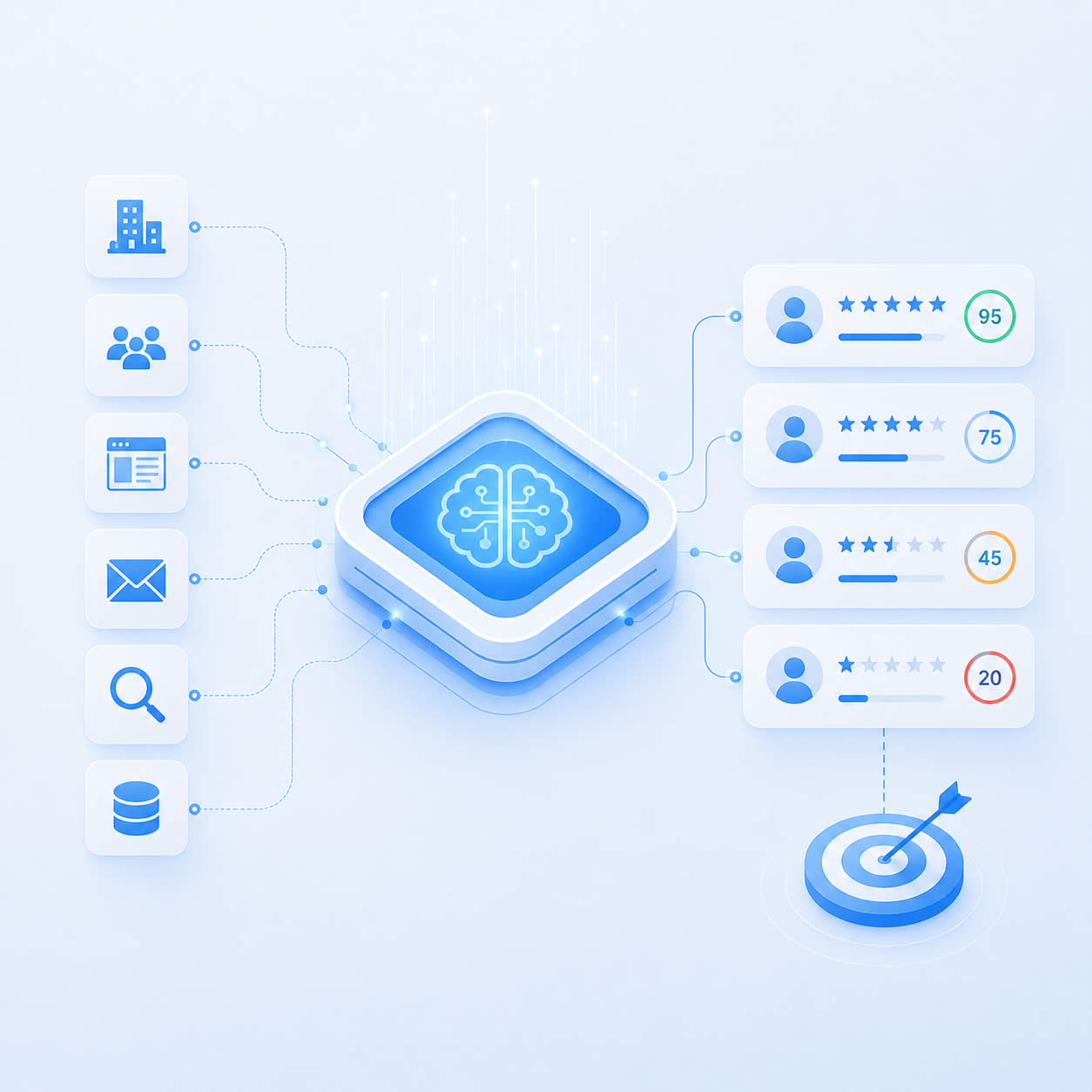
Key Takeaways
- AI lead scoring evaluates prospects using real business data, behavioral signals, and predictive analytics instead of static point-based systems.
- Combining Buying Signals, Intent Data, and Lead Enrichment enables businesses to identify prospects that are both qualified and sales-ready.
- AI continuously updates lead scores as companies grow, expand, hire, adopt new technology, or demonstrate changing purchasing intent.
- Better lead qualification allows sales teams to spend more time selling and less time chasing low-quality opportunities.
- AI-powered lead scoring creates stronger alignment between sales and marketing by using consistent qualification criteria.
- KatalystIQ combines AI Lead Generation, AI SDR, Sales Intelligence, Revenue Intelligence, AI Prospecting, and AI Outreach into one intelligent customer acquisition platform.
Lead Scoring & Qualification with AI
Every sales team faces the same challenge: there are always more leads than there is time to pursue them.
Some prospects are actively searching for a solution. Others are simply browsing. Some companies closely match your Ideal Customer Profile, while others were never likely to become customers in the first place. Unfortunately, without an effective qualification process, these very different opportunities often end up sitting together in the same CRM, competing for the same amount of attention.
This is where lead scoring becomes invaluable.
Lead scoring helps businesses determine which prospects deserve immediate attention, which require further nurturing, and which are unlikely to convert. Rather than treating every lead equally, sales teams can prioritize opportunities based on measurable characteristics and business activity.
Traditionally, this process relied on simple point-based systems. A prospect might receive points for visiting a website, downloading a brochure, or belonging to a certain industry. While these approaches represented an important step forward, they often struggled to capture the complexity of modern buying behaviour.
Artificial intelligence has fundamentally changed this process.
Modern AI Lead Generation platforms evaluate prospects using hundreds of data points instead of a handful of manually defined rules. They combine Sales Intelligence, Revenue Intelligence, Lead Enrichment, Buying Signals, Intent Data, and behavioural analysis to identify not only companies that fit your target market, but also those that are most likely to purchase.
Rather than asking, “Is this a lead?”, AI helps businesses answer a far more valuable question:
“Is this the right lead to contact right now?”
This subtle difference has a significant impact on sales productivity, conversion rates, and pipeline quality.
Modern sales organisations are increasingly combining AI with intelligent prospecting to eliminate guesswork and create a more predictable customer acquisition process. If you’re new to AI-powered sales, we recommend reading What Is AI Lead Generation?, What Is an AI SDR?, 20 Buying Signals Every Sales Team Should Track, How to Write Cold Emails That Get Replies, 10 Proven B2B Lead Generation Strategies, and 17 Common AI Sales Myths Debunked for additional context.
In this guide, we’ll explore how AI-powered lead scoring works, why traditional qualification methods often fall short, how Buying Signals, Intent Data, and Lead Enrichment improve lead quality, and how businesses can use AI to ensure their sales teams spend less time chasing unlikely prospects and more time speaking with companies that are genuinely ready to buy.
Because the fastest way to improve sales performance isn’t always generating more leads. Quite often, it’s simply recognising which leads deserve your attention first.
What Is Lead Scoring?
Lead scoring is the process of evaluating prospects to determine how likely they are to become customers.
Instead of treating every lead equally, businesses assign a score based on characteristics, behaviours, and business information. Higher scores indicate prospects that are a better fit for the business or are more likely to make a purchase.
This helps sales teams answer one of the most important questions in outbound sales:
“Who should we contact first?”
Without lead scoring, sales representatives often rely on instinct, incomplete information, or simply work through prospect lists in alphabetical order—which, surprisingly, has never been recognised as a sales strategy.
A lead score may be influenced by factors such as:
- Industry.
- Company size.
- Annual revenue.
- Job title.
- Geographic location.
- Website activity.
- Technology stack.
- Recent business growth.
- Engagement with marketing content.
Rather than replacing human judgement, lead scoring provides an objective way to prioritise opportunities.
Marketing teams can focus on generating qualified leads, while sales teams spend more time engaging prospects with the highest commercial potential.
When implemented correctly, lead scoring creates:
- Higher sales productivity.
- Faster response times.
- Improved conversion rates.
- Better pipeline visibility.
- More predictable revenue.
Simply put, lead scoring ensures your sales team spends time where it matters most.
Why Traditional Lead Scoring Falls Short
Traditional lead scoring systems were built around simple rules.
A company might receive:
- 10 points for downloading a brochure.
- 15 points for visiting the pricing page.
- 20 points for belonging to a target industry.
- 5 points for opening an email.
While these systems represented an important improvement over having no qualification process at all, they also introduced several limitations.
Business buying decisions are rarely driven by a single action.
A prospect downloading an eBook doesn’t necessarily indicate buying intent.
Someone visiting your pricing page may simply be curious.
A large enterprise isn’t automatically a better opportunity than a rapidly growing mid-sized business.
Traditional scoring also struggles to account for changing business conditions.
For example, it usually doesn’t recognise when a company:
- Raises new funding.
- Opens additional offices.
- Hires twenty new salespeople.
- Adopts a new technology platform.
- Launches a major product.
- Appoints a new executive team.
These events often have far greater influence on purchasing behaviour than whether someone clicked an email three weeks ago.
Rule-based scoring systems also require constant manual maintenance.
As markets evolve, customer behaviour changes, and products develop, someone must continually adjust scoring rules to keep them relevant.
This creates another challenge.
The rules themselves are usually based on assumptions.
Someone decides that opening an email is worth five points.
Another person decides attending a webinar is worth twenty.
But are those numbers actually accurate?
Traditional lead scoring often reflects educated guesses rather than measurable buying probability.
That doesn’t make it useless—but it does make it difficult to scale in increasingly complex sales environments.
What Is AI Lead Scoring?
AI Lead Scoring takes a fundamentally different approach.
Instead of relying solely on manually assigned rules, artificial intelligence evaluates prospects using large volumes of business data, behavioural signals, historical outcomes, and predictive analysis.
Rather than asking:
“How many points should this action receive?”
AI asks:
“Based on everything we know, how likely is this company to become a customer?”
This allows AI to evaluate far more information than traditional scoring systems can reasonably process.
For example, an AI model may consider:
- Firmographic information.
- Historical conversions.
- Company growth.
- Hiring activity.
- Technology adoption.
- Website engagement.
- Buying Signals.
- Intent Data.
- Lead Enrichment.
- Sales interactions.
Instead of relying on isolated events, AI looks for patterns.
It recognises combinations of behaviours that historically correlate with successful sales opportunities.
This enables businesses to prioritise leads with much greater confidence.
Modern AI Lead Generation platforms continuously update lead scores as new information becomes available.
If a prospect raises funding next week, opens three new offices next month, and begins hiring dozens of employees shortly after, their lead score can automatically increase without anyone manually updating CRM records.
AI Lead Scoring therefore becomes a living system rather than a static spreadsheet.
Combined with Sales Intelligence, Revenue Intelligence, Buying Signals, and Lead Enrichment, it helps sales teams focus on opportunities with the highest probability of success instead of simply those with the highest number of arbitrary points.
It’s a little like upgrading from a paper map to live GPS navigation. Both can help you reach your destination, but one continuously adapts as the road ahead changes.
How AI Lead Scoring Works
At its core, AI Lead Scoring is a pattern recognition problem.
Instead of evaluating a lead using a handful of manually defined rules, artificial intelligence analyses hundreds of data points simultaneously to estimate how likely a prospect is to become a customer.
The process typically follows several stages.
1. Data Collection
AI begins by gathering information from multiple business data sources.
These may include:
- CRM records.
- Company databases.
- Website activity.
- Email engagement.
- Social platforms.
- Public company announcements.
- Job postings.
- Technology databases.
- News sources.
The richer the available information, the more accurate the scoring model becomes.
2. Lead Enrichment
Raw contact information rarely provides enough context for effective qualification.
This is where Lead Enrichment becomes essential.
AI automatically enriches company records with additional business information such as:
- Industry.
- Employee count.
- Estimated revenue.
- Technology stack.
- Office locations.
- Decision-makers.
- Growth indicators.
- Company descriptions.
KatalystIQ combines enrichment across Multiple Lead Data Sources, creating significantly richer prospect profiles before scoring begins.
3. Pattern Analysis
AI then evaluates how closely each prospect resembles businesses that historically became successful customers.
Rather than relying on individual actions, it considers combinations of signals.
For example, a prospect might:
- Match your Ideal Customer Profile.
- Have recently secured funding.
- Be hiring aggressively.
- Be researching similar solutions.
- Use complementary technologies.
Each factor individually provides useful information.
Together, they provide a much stronger indication of purchasing potential.
4. Continuous Learning
Perhaps the biggest advantage of AI is that scoring models improve over time.
As more opportunities are won or lost, AI continuously refines its understanding of which characteristics are most strongly associated with successful sales outcomes.
This allows lead scores to evolve as customer behaviour changes.
Instead of requiring someone to manually adjust scoring rules every few months, AI continuously learns from real business results.
Firmographic Data vs Behavioral Data
Not all lead data is equally valuable.
Some information describes who the prospect is.
Other information describes what the prospect is doing.
Both are important.
Understanding the difference helps explain why AI Lead Scoring is significantly more accurate than traditional approaches.
Firmographic Data
Firmographic information describes the characteristics of a business.
This includes information such as:
- Industry.
- Company size.
- Revenue.
- Location.
- Employee count.
- Technology stack.
- Business model.
Firmographic data helps determine whether a company fits your Ideal Customer Profile.
It answers questions like:
- Is this the type of business we typically serve?
- Can they realistically afford our solution?
- Do they operate in our target industries?
Firmographic data is excellent for determining fit.
However, it says very little about timing.
Behavioral Data
Behavioral data focuses on what companies are actively doing.
This includes activities such as:
- Website visits.
- Email engagement.
- Content downloads.
- Webinar attendance.
- Hiring.
- Technology adoption.
- Business expansion.
- Product launches.
Behavioral information provides valuable insight into buying readiness.
A company that perfectly matches your Ideal Customer Profile may still not be ready to purchase.
Another company showing strong behavioural signals may represent a much better immediate opportunity.
The most effective AI models combine both types of information.
They identify businesses that are both:
- A strong fit.
- Showing signs of active buying intent.
That combination significantly improves lead qualification.
How Buying Signals Improve Lead Qualification
One of the biggest limitations of traditional lead scoring is that it often ignores what is actually happening inside a business.
A company isn’t more likely to purchase simply because it belongs to a certain industry.
It becomes more likely to purchase when meaningful change is taking place.
This is where Buying Signals become incredibly valuable.
Buying Signals are measurable business events that suggest an organisation may be entering a period of increased purchasing activity.
Examples include:
- Hiring new employees.
- Opening new offices.
- Receiving investment.
- Launching products.
- Leadership changes.
- Technology upgrades.
- Strategic partnerships.
Rather than treating every company equally, AI continuously monitors these events and automatically adjusts lead scores as new information becomes available.
For example, imagine two companies that both perfectly match your Ideal Customer Profile.
One has remained largely unchanged for several years.
The other has recently:
- Raised funding.
- Hired thirty new employees.
- Opened two regional offices.
- Implemented new technology.
Traditional scoring may assign similar scores to both businesses.
AI recognises that the second company is demonstrating significantly stronger commercial momentum.
Businesses interested in learning more about these indicators should also read 20 Buying Signals Every Sales Team Should Track.
By combining Buying Signals with Sales Intelligence, Revenue Intelligence, and AI Prospecting, AI identifies opportunities that are not only qualified but also well-timed.
Because in sales, the right company at the wrong time can be almost as challenging as the wrong company altogether.
Using Intent Data to Prioritize Prospects
Knowing that a company fits your Ideal Customer Profile is valuable.
Knowing that they are actively researching solutions like yours is even better.
This is exactly what Intent Data provides.
Intent Data captures behavioural patterns that indicate a business may be evaluating products or services before they ever contact a vendor.
These behaviours may include:
- Reading industry articles.
- Comparing software providers.
- Researching solution categories.
- Downloading educational content.
- Visiting relevant websites.
- Engaging with solution-specific topics.
Unlike firmographic information, Intent Data reflects current interest rather than static business characteristics.
Combined with Buying Signals, it creates a far more accurate picture of purchasing readiness.
Consider these two companies:
- Both match your Ideal Customer Profile.
- Both have similar revenue.
- Both operate in your target industry.
However:
- One has shown no recent activity.
- The other is actively researching your solution category while expanding its business.
Which would your sales team rather contact?
The answer is usually obvious.
Intent Data helps AI separate curiosity from genuine buying potential.
Rather than overwhelming sales representatives with every possible prospect, AI prioritises those demonstrating measurable commercial intent.
This improves:
- Sales productivity.
- Response rates.
- Pipeline quality.
- Conversion rates.
- Forecast accuracy.
AI continuously evaluates new behavioural information, ensuring lead scores remain current as businesses move through their buying journey.
Lead Enrichment: Why Better Data Creates Better Scores
Artificial intelligence is only as effective as the information it receives.
If prospect records contain only a company name and email address, even the most sophisticated AI model has very little context for making qualification decisions.
This is why Lead Enrichment plays such an important role in AI Lead Scoring.
Lead Enrichment automatically supplements basic prospect records with valuable business information.
This may include:
- Industry classification.
- Company size.
- Employee count.
- Estimated revenue.
- Headquarters location.
- Technology stack.
- Decision-makers.
- Business description.
- Social profiles.
- Growth indicators.
Instead of asking sales representatives to research every company manually, AI gathers this information automatically using Multiple Lead Data Sources.
The additional context improves qualification in several ways.
- Higher scoring accuracy.
- Better personalization.
- Improved segmentation.
- Smarter prospect prioritisation.
- More effective outreach.
Enriched data also supports stronger decision-making throughout the sales process.
When sales representatives understand the prospect’s business before making contact, conversations become significantly more relevant.
Good lead scoring begins with good data.
Great lead scoring begins with comprehensive data.
Building an AI-Powered Ideal Customer Profile (ICP)
Lead scoring becomes significantly more effective when AI clearly understands what an ideal customer actually looks like.
Many businesses define an Ideal Customer Profile using only basic criteria such as:
- Industry.
- Company size.
- Revenue.
- Location.
While these characteristics remain important, AI allows businesses to create much richer customer profiles.
Instead of focusing only on demographics, AI also learns:
- Common customer challenges.
- Buying behaviours.
- Growth patterns.
- Technology preferences.
- Sales cycles.
- Expansion indicators.
- Historical conversion patterns.
KatalystIQ takes this a step further through AI Learns Your Business.
Rather than relying solely on predefined scoring rules, the platform learns your:
- Products and services.
- Ideal Customer Profile.
- Buyer personas.
- Competitive advantages.
- Business terminology.
- Sales messaging.
This understanding allows AI to evaluate prospects using criteria that are unique to your business rather than generic industry assumptions.
The result is qualification that becomes increasingly aligned with your real customers over time.
Automatic Lead Qualification with AI
Lead scoring determines how promising a prospect appears.
Lead qualification determines what happens next.
Traditionally, qualification required sales representatives to manually review every lead before deciding whether it deserved further attention.
This process often involved:
- Reviewing CRM records.
- Checking company websites.
- Researching LinkedIn.
- Reading recent news.
- Evaluating company size.
- Searching for decision-makers.
While effective, this approach consumes significant time.
AI automates much of this work.
Instead of manually reviewing every prospect, AI automatically:
- Evaluates lead quality.
- Performs Lead Enrichment.
- Identifies Buying Signals.
- Analyses Intent Data.
- Calculates lead scores.
- Ranks opportunities.
- Recommends next actions.
This allows sales teams to spend less time qualifying prospects and more time engaging qualified opportunities.
Businesses using AI Lead Generation and AI Sales Automation can significantly reduce manual administrative work while maintaining consistent qualification standards across the organisation.
Rather than replacing sales representatives, AI becomes an intelligent assistant that continuously prepares the next best opportunities for human engagement.
Think of it as having an analyst who never sleeps, never forgets to update the CRM, and never says, “I’ll look into that tomorrow.”
Predictive Lead Scoring Explained
Traditional lead scoring tells you how well a prospect matches predefined criteria.
Predictive lead scoring goes one step further.
Instead of relying solely on current information, AI estimates the likelihood that a prospect will become a customer based on historical patterns, behavioural trends, and continuously evolving business data.
Think of it as moving from a snapshot to a forecast.
Rather than asking:
“Does this company fit our Ideal Customer Profile?”
Predictive AI asks:
“Based on everything we know, how likely is this company to convert?”
To answer that question, AI evaluates combinations of factors including:
- Firmographic data.
- Historical buying behaviour.
- Industry trends.
- Buying Signals.
- Intent Data.
- Lead Enrichment.
- Previous customer success patterns.
- Sales engagement history.
As new information becomes available, predictive scores automatically evolve.
A company that receives new funding, hires aggressively, launches a product, and begins researching solutions may rapidly move from a low-priority lead to one of your highest-value opportunities.
This dynamic scoring allows sales teams to react to changing business conditions rather than relying on outdated CRM records.
Predictive lead scoring doesn’t predict the future with absolute certainty.
Instead, it helps businesses make significantly better decisions using the information available today.
How AI Helps Sales Teams Prioritize Their Pipeline
Most sales pipelines have the opposite problem people expect.
They don’t contain too few leads.
They contain too many leads competing for limited attention.
Without prioritisation, sales representatives often:
- Contact low-quality prospects.
- Miss high-intent opportunities.
- Spend excessive time researching.
- Delay follow-ups.
- Waste effort on poor-fit companies.
AI helps eliminate this problem by continuously ranking opportunities according to commercial potential.
Instead of presenting one long alphabetical prospect list, AI identifies:
- Highest priority leads.
- Recently qualified opportunities.
- Accounts showing new Buying Signals.
- Companies demonstrating Intent Data.
- Prospects requiring immediate follow-up.
This enables sales teams to focus their efforts where they are most likely to generate revenue.
Better prioritisation leads to:
- Faster response times.
- Higher conversion rates.
- Improved sales productivity.
- Healthier pipelines.
- More predictable forecasting.
Rather than spending mornings deciding who deserves attention first, sales representatives can begin conversations with confidence that AI has already performed much of the qualification work.
Common Lead Scoring Mistakes to Avoid
Even sophisticated organisations can reduce the effectiveness of lead scoring through a handful of common mistakes.
If you’re implementing AI-powered qualification, avoid these pitfalls:
- Scoring leads using only firmographic data.
- Ignoring Buying Signals.
- Ignoring Intent Data.
- Working with incomplete prospect records.
- Treating all industries the same.
- Failing to update qualification criteria.
- Prioritising lead quantity over quality.
- Using static scoring rules indefinitely.
- Not aligning sales and marketing qualification standards.
- Failing to validate scoring against actual conversion outcomes.
The objective isn’t to build the most complicated scoring model.
The objective is to build one that consistently helps your sales team spend time on the right opportunities.
How AI SDRs Use Lead Scores to Personalize Outreach
Lead scores become significantly more valuable when they influence how outreach is performed.
This is where AI SDR technology becomes particularly powerful.
Rather than sending identical messages to every prospect, AI SDRs adapt outreach based on lead quality, business context, and purchasing readiness.
For example:
- High-scoring prospects may receive immediate personalised outreach.
- Medium-scoring leads may enter automated nurturing campaigns.
- Low-scoring prospects can remain under observation until stronger Buying Signals emerge.
AI SDRs also use qualification data to personalise messaging.
Instead of generic introductions, outreach can reference:
- Hiring initiatives.
- Business expansion.
- Technology adoption.
- Recent funding.
- Industry developments.
- Product launches.
This allows businesses to combine intelligent prioritisation with meaningful communication.
For a deeper understanding of AI SDR technology, read What Is an AI SDR?.
How KatalystIQ Automates Lead Scoring and Qualification
Lead scoring is most effective when it operates continuously rather than as an occasional CRM exercise.
KatalystIQ combines AI Lead Generation, AI Prospecting, Lead Enrichment, Sales Intelligence, Revenue Intelligence, Buying Signals, Intent Data, AI SDR, AI Outreach, and AI Sales Automation into one intelligent customer acquisition platform.
Rather than asking sales teams to manually qualify every prospect, KatalystIQ automatically:
- Discovers qualified companies.
- Monitors Buying Signals continuously.
- Performs Lead Enrichment.
- Learns your Ideal Customer Profile through AI Learns Your Business.
- Calculates dynamic lead scores.
- Ranks sales opportunities.
- Deploys intelligent Lead Machines & AI SDRs.
- Generates personalised AI Outreach.
Businesses seeking expert implementation can also leverage KatalystIQ Velocity, our premium implementation and AI growth service.
Velocity helps organisations deploy AI successfully through strategy, workflow design, CRM integration, custom Lead Machines, AI SDR implementation, and continuous optimisation.
The result is a scalable customer acquisition engine that continuously identifies, qualifies, prioritises, and engages the opportunities most likely to generate revenue.
Best Practices for AI Lead Scoring
To maximise the value of AI Lead Scoring, follow these best practices:
- Clearly define your Ideal Customer Profile.
- Continuously enrich lead data.
- Monitor Buying Signals automatically.
- Combine Intent Data with firmographic information.
- Continuously validate scoring against actual sales outcomes.
- Prioritise quality over lead volume.
- Keep sales and marketing qualification criteria aligned.
- Allow AI models to evolve with changing customer behaviour.
- Personalise outreach using lead intelligence.
- Review pipeline priorities regularly.
Conclusion
Lead scoring has evolved from a simple point-based exercise into one of the most valuable applications of artificial intelligence in modern sales. Rather than relying on assumptions or static qualification rules, AI continuously analyses business information, behavioural signals, and historical outcomes to help organisations focus on the opportunities most likely to convert.
When combined with Buying Signals, Intent Data, Lead Enrichment, Sales Intelligence, and Revenue Intelligence, AI creates a far richer understanding of every prospect. Instead of asking whether a company fits your Ideal Customer Profile, businesses can identify which prospects are genuinely ready for meaningful conversations today.
KatalystIQ brings these capabilities together into a single intelligent platform, combining AI Lead Generation, AI Prospecting, AI SDR, AI Outreach, and AI Sales Automation to help businesses discover, qualify, prioritise, and engage high-value opportunities automatically. Combined with KatalystIQ Velocity, organisations gain both the technology and the expertise needed to build a predictable, scalable customer acquisition engine.
At the end of the day, sales teams don’t need more leads—they need more of the right leads. AI Lead Scoring makes that possible by ensuring every conversation begins with a prospect that deserves your attention, rather than one that simply happened to appear at the top of a spreadsheet.
Frequently Asked Questions
AI Lead Scoring is the process of using artificial intelligence to evaluate and rank prospects based on their likelihood of becoming customers. Unlike traditional rule-based scoring, AI analyses hundreds of data points including firmographic information, behavioural activity, Buying Signals, Intent Data, and historical conversion patterns. This enables sales teams to focus on opportunities with the highest probability of success.
Traditional lead scoring typically assigns fixed points to specific actions, such as opening an email or visiting a webpage. AI Lead Scoring continuously analyses multiple factors simultaneously and adapts as new information becomes available. Instead of relying on static rules, AI learns from historical outcomes to produce more accurate and dynamic lead scores.
AI evaluates a wide range of information including company size, industry, revenue, technology stack, website engagement, hiring activity, funding announcements, leadership changes, Buying Signals, Intent Data, and Lead Enrichment. By combining multiple data sources, AI builds a more complete picture of each prospect’s likelihood of purchasing. This results in better prioritisation than relying on a single metric.
Buying Signals are measurable business events that indicate a company may be entering a purchasing cycle. Examples include hiring, business expansion, funding announcements, technology adoption, product launches, and executive appointments. AI continuously monitors these signals to automatically adjust lead scores as business conditions change.
Intent Data helps identify companies that are actively researching solutions related to your products or services. It complements firmographic information by revealing buying behaviour rather than simply describing the company. Combining Intent Data with Buying Signals significantly improves lead qualification accuracy.
Lead Enrichment supplements basic prospect records with additional business information such as employee count, estimated revenue, technologies used, decision-makers, locations, and company descriptions. The richer the available information, the more accurately AI can qualify and prioritise opportunities. Better data almost always produces better lead scores.
Yes. Modern AI platforms automatically analyse prospect data, monitor business activity, calculate lead scores, identify Buying Signals, evaluate Intent Data, and recommend next actions without requiring extensive manual review. Sales teams can then focus on engaging qualified opportunities rather than spending hours researching every prospect individually.
AI SDR platforms use lead scores to prioritise outreach and personalise communication. High-scoring prospects may receive immediate personalised engagement, while lower-scoring leads can enter automated nurturing campaigns until stronger buying indicators emerge. This ensures sales teams invest their time where it is most likely to generate results.
KatalystIQ combines AI Lead Generation, AI Prospecting, Lead Enrichment, Sales Intelligence, Revenue Intelligence, Buying Signals, Intent Data, AI SDR, and AI Outreach into one intelligent platform. It continuously discovers prospects, enriches company information, calculates dynamic lead scores, prioritises opportunities, and prepares personalised outreach, helping businesses build a more predictable sales pipeline.
Absolutely. AI Lead Scoring is valuable for businesses of all sizes because every sales team has limited time and resources. By automatically identifying the highest-value opportunities, smaller organisations can compete more effectively without increasing headcount. AI helps teams spend less time chasing unqualified leads and more time building relationships with prospects that are genuinely ready to buy.